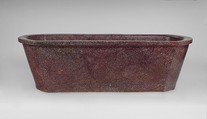
Porphyry support for a water basin
Artwork Details
- Title: Porphyry support for a water basin
- Period: Mid-Imperial
- Date: 2nd century CE
- Culture: Roman
- Medium: Porphyry
- Dimensions: H. 30 in. (76.2 cm)
width 58 1/4 in. (148 cm)
Weight approx. 900 lbs - Classification: Stone Sculpture
- Credit Line: Harris Brisbane Dick Fund, 1992
- Object Number: 1992.11.70
- Curatorial Department: Greek and Roman Art
Audio
1243. Porphyry support for a water basin
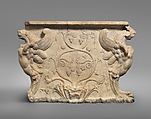
What remarkable color! This massive sculpture—one of a pair—originally supported a deep oblong water basin. The enormous water basin stood in one of the grand halls of an imperial bath complex. Notice how each end is carved with a lion’s head, acanthus leaves, and an enormous, commanding paw. The entire outer side of the support is embellished with a foliate design that sprouts from a central, lotus-like motif. Delicate, curling vines with buds and flowers demonstrate remarkable grace and sensitivity.
This reddish-purple stone is known as porphyry. It is extremely hard, and very difficult to work. In antiquity, porphyry was highly regarded as an imperial stone, most likely because of its color—purple was the color of royalty—and, for its rare occurrence. The porphyry used in Imperial Rome came from a single quarry in the eastern desert of Egypt that was under the total control of the Roman Emperor. Its use in architecture and sculpture understandably remained quite limited.
This porphyry support exemplifies the opulence of Roman imperial sculpture. Its carefully articulated details and perfectly polished surface attest to the artist’s command over the most noble, and most difficult to work of all colored stones.
More Artwork
Related Content
 Free to download
Research Resources
The Met provides unparalleled resources for research and welcomes an international community of students and scholars. The Met's Open Access API is where creators and researchers can connect to the The Met collection. Open Access data and public domain images are available for unrestricted commercial and noncommercial use without permission or fee.
To request images under copyright and other restrictions, please use this Image Request form.
Feedback
We continue to research and examine historical and cultural context for objects in The Met collection. If you have comments or questions about this object record, please contact us using the form below. The Museum looks forward to receiving your comments.
Content Notice
The Metropolitan Museum of Art presents over 5,000 years of art from around the world, and our online collection reflects ongoing work conducted over the course of our more than 150-year history. You may encounter objects or images that may be inappropriate for some viewers or information that may be outdated.