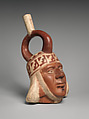
Stirrup-spout bottle with peanut figure
The figure’s gender is indeterminate but appears more male-presenting based on traits associated with masculine depictions as well as the absence of feminine markers. Male figures commonly wear short, decorated, unbelted, sleeved tunics; women are usually depicted with braids or tresses. Accessories such as headdresses, earspools, or nose ornaments, usually worn by elite men or powerful women adopting male attributes, are absent. This absence suggests the figure is neither elite nor female, but possibly male or intentionally ambiguous. As many scholars note, however, gender identification in Moche art should remain tentative unless clearly marked.
This vessel exemplifies the polysemy present in Moche art. It can be seen as an anthropomorphized, animated peanut or as a human figure cloaked in a garment that mimics a peanut shell. The artist skillfully modeled the peanut shell to resemble a garment, its texture emphasized through a repeated dotted pattern and raised lines that evoke the fibrous veins of a peanut. The shell does not fully enclose the figure’s body as in other peanut-related vessels. Instead, it cascades from the head and shoulders down to the feet. Attention to the figure’s neck reveals how drapery is rendered in the clay to show the gathering of the peanut shell, like fabric. One end of the shell extends upward toward the figure’s head, tapering into a pointed form that bends forward, possibly meant to resemble conical Moche head accessories. Other peanut-themed vessels feature elements like neckties and collars, further reinforcing the visual analogy to clothing (see MMA 1979.206.1114).
Peanuts, native to South America, have been a feature of Peruvian cuisine for millennia, as well as a subject for artistic expression. Representations of peanuts are found in a variety of media, but they are typically only animated in this vessel type. The peanut is unique in the legume family because it grows underground, similar to tubers. This growth process could be a factor in the Moche’s association of peanuts (and certain tubers) with death, internment, and regeneration. Ceramic vessels depicting plates of peanuts found in burials, further supports the connection to death rituals.
Eva Zapata Signorino, Adrienne Arsht Intern, 2025
References and Further Reading:
Bernier, Hélène. "Personal Adornments at Moche, North Coast of Peru." Ñawpa Pacha: Journal of Andean Archaeology 30, no. 1 (2010): 91–114.
Donnan, Christopher B. Moche Art of Peru: Pre-Columbian Symbolic Communication. Fowler Museum of Cultural History, California, Los Angeles, 1978.
Donnan, Christopher B., and Donna McClelland. Moche Fineline Painting: Its Evolution and Its Artists. Fowler Museum of Cultural History, California, Los Angeles, 1999.
Jackson, Margaret A. Moche Art and Visual Culture in Ancient Peru. University of New Mexico Press, 2008.
Koons, Michele L., Branden Cesare Rizzuto, and Lisa Trever, et al. "Moche Chronology of Ancient Peru: Bayesian Assessment of Radiocarbon Dates and Ceramic Styles from North to South." Quaternary International 703 (2024): 82-96.
Larco Hoyle, Rafael. Los mochicas. Vol. 1. Museo Arqueológico Rafael Larco Herrera- Fundación Telefónica, 2001.
Montell, Gösta. Dress and Ornamentation in Ancient Peru, Archaeological and Historical Studies. Elanders boktryckeri aktiebolag, 1929.
Scher, Sarahh E. M. "High-Ranking Women and Masculine Imagery in Moche Art and Burial Ensembles." In Dressing the Part: Power, Dress, and Representation in the Pre- Columbian Americas, edited by Sarahh E. M. Scher and Billie J. A. Follensbee, 450-481. University Press of Florida, 2017.
Trever, Lisa. "A Moche Riddle in Clay: Object Knowledge and Art Work in Ancient Peru." The Art Bulletin 101, no. 4 (2019): 18–38.
Artwork Details
- Title: Stirrup-spout bottle with peanut figure
- Artist: Moche artist(s)
- Date: 500–800 CE
- Geography: Peru
- Culture: Moche
- Medium: Ceramic, slip
- Dimensions: H. 8 in. × W. 6 1/8 in. (20.3 × 15.5 cm)
- Classification: Ceramics-Containers
- Credit Line: Gift of Mr. and Mrs. Nathan Cummings, 1964
- Object Number: 64.228.37
- Curatorial Department: The Michael C. Rockefeller Wing
More Artwork
Related Content
 Free to download
Research Resources
The Met provides unparalleled resources for research and welcomes an international community of students and scholars. The Met's Open Access API is where creators and researchers can connect to the The Met collection. Open Access data and public domain images are available for unrestricted commercial and noncommercial use without permission or fee.
To request images under copyright and other restrictions, please use this Image Request form.
Feedback
We continue to research and examine historical and cultural context for objects in The Met collection. If you have comments or questions about this object record, please contact us using the form below. The Museum looks forward to receiving your comments.
Content Notice
The Metropolitan Museum of Art presents over 5,000 years of art from around the world, and our online collection reflects ongoing work conducted over the course of our more than 150-year history. You may encounter objects or images that may be inappropriate for some viewers or information that may be outdated.