Shell Vessel
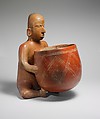
Archaeologists have posited that these animal effigy vessels could have represented offerings in sculpted form. Examples of faunal representations including dogs (MMA 2007.345.1), turtles (2007.345.5), and sea snails would have represented part of the daily diet of Pacific Coastal communities (Schöndube 1998: 210–211). Animal shell and bone were also sometimes crafted into wind and percussion instruments, including some examples of lobatus gigas (formerly called strombus gigas) conchs that are imported from the Caribbean (Mountjoy 1998: 255, 258). Archaeological examples of conch shell trumpets reveal a series of drilled perforations that could be variably covered to produce different musical pitches and likely used for social and religious ceremonies. Modeled on the figure's spire is a large, rimless spout—indicating this sculpture could have been used as a functional container for liquid, stored in the conch's body. It could have served many roles, providing a pragmatic need as a serving vessel while also eliciting a spiritual nourishment in the shape of a sacred instrument and vital food source rendered in clay.
Named after the modern Mexican state in which these sculptures have been found, the Colima cultural area is located on the central Pacific Coast. Colima ceramics are often produced using a local clay of orange or brown hues with applied deep red paint or slip. This figure would have been modeled by hand, using techniques of coiling and beating of malleable clay to produce its features. The artist would have used a stylus to cut into the surface, revealing the disparate grey colored clay to reveal the inclination of the vessel body and sloped ridges of the carapace. Like many Colima figures, this example is highly burnished, a process by which clay sculptors carefully rubbed the exterior with a smooth stone or other abrasive materials to produce its luminous luster.
Beginning in the first millennium BCE, vessels like this one were part of funerary assemblages placed in shaft tombs. These are deep, rectangular burial structures consisting of a series of cavernous tunnels and adjacent chambers for several interred individuals. They were likely multigenerational, with ceramic offerings representing vital vignettes to accompany the deceased into the afterlife. Additional offerings included spondylus shell, jade, greenstone, tecomate (gourd), and woven textiles. During this period, this was a shared cultural process of ritual interment throughout what are now the western coastal states of Jalisco, Nayarit and Colima.
Brandon Agosto, 2026
Further reading:
Beekman, Christopher S., and Robert S. Pickering. Shaft Tombs and Figures in West Mexican Society: A Reassessment. Edited by Christopher S. Beekman, and Robert S. Pickering. Tulsa: Thomas Gilcrease Institute of American History and Art, 2016.
Butterwick, Kristi. Heritage of Power: Ancient Sculpture From West Mexico: The Andrall E. Pearson Family Collection. New York, New Haven, London: The Metropolitan Museum of Art, 2004.
Hernández Díaz, Verónica. "Muerte y vida en la cultura tumbas de tiro", in Miradas renovadas al Occidente indígena de México, edited by Marie Areti Hers, pp. 79–131. Mexico: Mexico Instituto de Investigaciones Estéticas, UNAM, 2013.
Meighan, Clement W., and H.B. Nicholson. "The Ceramic Mortuary Offerings of Prehistoric West Mexico: An Archaeological Perspective." In: Sculpture of Ancient West Mexico. Nayarit, Jalisco, Colima. A Catalogue of the Proctor Stafford Collection at the Los Angeles County Museum of Art, Revised edition, by Michael Kan, Clement Meighan, and H. B. Nicholson, pp. 29-67. Los Angeles: Los Angeles County Museum of Art, 1989.
Mountjoy, Joseph B. "The Evolution of Complex Societies in West Mexico: A Comparative Perspective." In: Ancient West Mexico: Art and Archaeology of the Unknown Past. Edited by Richard Townsend, 251–265, 1998.
Olay Barrientos, María de los Ángeles, and Andrés Saúl Alcántara Salinas. "La tumba de las Fuentes, Colima. Notas sobre los contextos funerarios de las élites hacia el fin de la fase Comala. In Memoria I Foro Colima y su Región Arqueología, Antropología e Historia, edited by Juan Carlos Reyes G., pp. 1-34, Mexico: Secretaría de Cultura, Gobierno, del Estado de Colima.
Pickering Robert B., Cheryl Smallwood-Roberts and Thomas Gilcrease Institute of American History and Art. West Mexico. Ritual and Identity. Tulsa, Oklahoma: Thomas Gilcrease Institute of American History and Art, 2016.
Schöndube, Otto. "Natural Resources and Human Settlements in Ancient West Mexico." In: Ancient West Mexico: Art and Archaeology of the Unknown Past. Edited by Richard Townsend, 205–215, 1998.
Townsend, Richard, ed. Ancient West Mexico: Art and Archaeology of the Unknown Past. Chicago: Art Institute of Chicago, 1998.
Zavaleta Lucido, Marcos Trinidad and Rosa María Flores Ramírez. "The shaft tombs of Parcelas 12, 19, and 25 and their inhabitants: Funerary considerations on recent archaeological finds in Colima," in: Shaft Tombs and Figures in West Mexican Society: A Reassessment. Edited by Christopher S. Beekman and Robert S. Pickering, pp. 55–72 Tulsa: Thomas Gilcrease Institute of American History and Art, 2016.
Artwork Details
- Title: Shell Vessel
- Artist: Colima artist(s)
- Date: 200 BCE–300 CE
- Geography: Mexico, Colima
- Culture: Colima
- Medium: Ceramic, slip
- Dimensions: H. 5 × W. 7 × D. 10 3/4 in. (12.7 × 17.8 × 27.3 cm)
- Classification: Ceramics-Containers
- Credit Line: Gift of Arthur M. Bullowa, 1979
- Object Number: 1979.205.5
- Curatorial Department: The Michael C. Rockefeller Wing
More Artwork
Research Resources
The Met provides unparalleled resources for research and welcomes an international community of students and scholars. The Met's Open Access API is where creators and researchers can connect to the The Met collection. Open Access data and public domain images are available for unrestricted commercial and noncommercial use without permission or fee.
To request images under copyright and other restrictions, please use this Image Request form.
Feedback
We continue to research and examine historical and cultural context for objects in The Met collection. If you have comments or questions about this object record, please contact us using the form below. The Museum looks forward to receiving your comments.
Content Notice
The Metropolitan Museum of Art presents over 5,000 years of art from around the world, and our online collection reflects ongoing work conducted over the course of our more than 150-year history. You may encounter objects or images that may be inappropriate for some viewers or information that may be outdated.