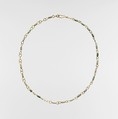
Necklace with conical beads
The present group consists of 60 beads, similarly shaped, but created four sizes: 7 large (each about 7 cm in diameter), 30 medium (about 4 cm in diameter), 11 small (about 2.5 cm in diameter) and 12 extra-small (a bit less that 2 cm in diameter). Unlike the impressive beads excavated by Walter Alva and his team at Sipán, on Peru’s North Coast, these 60 beads were acquired via the art market in the 1950s, so their original configuration is unknown. In the middle of the 20th century, all 60 beads were mounted together in one necklace of two strands, in a graduated design, with the smallest beads nearest the clasp and the largest at the center. Following patterns revealed by Alva (2001), Alva and Donnan (1993), Bourget (2014), and Donnan (2022, 2012), based on their scientific excavations of high-status Moche tombs, however, it seems likely that this group of 60 beads once constituted several, rather than a single necklace. Although it is impossible to reconstruct their original layout, the present photograph follows a Moche preference for stringing beads of the same size on one strand, possibly next to other strands of beads, placing the largest beads on the outermost strand. Again, following patterns seen in the archaeological record, the necklaces likely did not extend to the nape, or back of the neck.
Each bead in this group has a lenticular shape with one plain side and one side with a conical protrusion, perhaps representing a lucuma fruit, known for its sweet, bright yellow flesh. Moche artists also created ceramic vessels in the shape of lucuma fruit, often clustered in threes or fours (see, for example, a bottle in the collection of the Museo Larco in Lima, accession number ML006628). In the absence of texts from this period (there was no tradition of writing in the Andes prior to the 16th century), it is difficult to determine with precision what the symbolic association may have been, although a connection with an idea of enduring abundance was surely a consideration. Two beads of a similar shape and size of the medium-scale beads are reported to have come from the site of Sipán in Lambayeque, prior to the initiation of Walter Alva’s scientific excavations there in 1987 (Alva, 2001:233; see also Bonavia 1994:145, fig. 111).
The Moche (also known as the Mochica) flourished on Peru’s North Coast from 200-850 CE, centuries before the rise of the Incas. Over the course of some seven centuries, the Moche transformed the strip of desert between the Pacific Ocean and the Andean highlands into thriving regional centers from the Nepeña River Valley in the south to as far north as the Piura River, near the modern border with Ecuador. They developed the coastal deserts into rich farmlands through the invention and expansion of complex irrigation systems and drew upon the abundant maritime resources of the Pacific Ocean’s Humboldt Current. Monumental buildings, made of mudbrick, were the center of Moche ceremonial life and were built in each valley. These centers were often hubs for craft production, places where Moche artists technologically and aesthetically achieved new heights. Although the precise nature of Moche political organization is unknown, these centers shared unifying cultural traits such as religious practices (Donnan, 2010).
Joanne Pillsbury
Andrall E. Pearson Curator, Arts of the Ancient Americas, 2026
References and Further Reading
Alva, Walter, ed. Gold aus dem alten Peru: die Königsgräber von Sipán. Berlin: Hatje Cantz Verlag, 2001.
Alva, Walter, and Christopher B. Donnan. Royal Tombs of Sipán. Los Angeles: Fowler Museum of Culture History, 1993.
Bonavia, Duccio. Arte e historia del Perú antiguo: Colección Enrico Poli. Arequipa, Peru: Banco del Sur, 1994.
Bourget, Steve. Les rois mochica: Divinité et pouvoir dans le Pérou ancien. Paris: Somogy éditions d'art; Geneva: MEG, Musée d'ethnographie de Genève, 2014.
Donnan, Christopher B. La Mina: A Royal Moche Tomb. Albuquerque: University of New Mexico Press, 2022.
Donnan, Christopher B. "Dressing the Body in Splendor: Expression of Value by the Moche of Ancient Peru." In The Construction of Value in the Ancient World, edited by John K. Papadopoulos and Gary Urton, pp. 186-196. Los Angeles: Cotsen Institute of Archaeology Press, 2012.
Donnan, Christopher B. "Moche State Religion." In New Perspectives on Moche Political Organization, edited by Jeffrey Quilter and Luis Jaime Castillo, pp. 47-69. Washington D.C.: Dumbarton Oaks Research Library and Collection, 2010.
Donnan, Christopher B. Moche Art of Peru: Pre-Columbian Symbolic Communication. Los Angeles: Museum of Cultural History, 1978.
Mujica Barreda, Elías. El Brujo: Huaca Cao, centro ceremonial Moche en el valle de Chicama/Huaca Cao, a Moche Ceremonial Center in the Chicama Valley. Lima: Fundación Wiese, 2007.
Pillsbury, Joanne, Timothy Potts, and Kim N. Richter. Golden Kingdoms: Luxury Arts in the Ancient Americas. Los Angeles: J. Paul Getty Museum, 2017.
Artwork Details
- Title: Necklace with conical beads
- Artist: Moche artist(s)
- Date: 200-850 CE
- Geography: Peru
- Culture: Moche
- Medium: Gold
- Dimensions: Overall dims.: 16 × 14 1/2 × 2 3/4 in. (40.6 × 36.8 × 7 cm)
Other (7 large beads): 2 3/4 × 2 1/2 in. (7 × 6.4 cm)
Other (30 medium beads): 1 1/2 × 1 3/4 in. (3.8 × 4.4 cm)
Other (11 small beads): 1 × 1 1/8 in. (2.5 × 2.9 cm)
Other (12 xs beads): 5/8 × 3/4 in. (1.6 × 1.9 cm) - Classification: Beads-Ornaments
- Credit Line: The Michael C. Rockefeller Memorial Collection, Bequest of Nelson A. Rockefeller, 1979
- Object Number: 1979.206.450.1–.60
- Curatorial Department: The Michael C. Rockefeller Wing
More Artwork
Research Resources
The Met provides unparalleled resources for research and welcomes an international community of students and scholars. The Met's Open Access API is where creators and researchers can connect to the The Met collection. Open Access data and public domain images are available for unrestricted commercial and noncommercial use without permission or fee.
To request images under copyright and other restrictions, please use this Image Request form.
Feedback
We continue to research and examine historical and cultural context for objects in The Met collection. If you have comments or questions about this object record, please contact us using the form below. The Museum looks forward to receiving your comments.
Content Notice
The Metropolitan Museum of Art presents over 5,000 years of art from around the world, and our online collection reflects ongoing work conducted over the course of our more than 150-year history. You may encounter objects or images that may be inappropriate for some viewers or information that may be outdated.