Chuspa (coca bag)
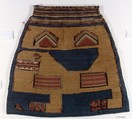
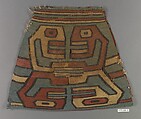
Created from fine yarns of camelid fiber woven in a tapestry technique, this delicate textile stands out for its rich color saturation. The craftswoman wove the fabric with the intention of making a bag (chuspa) to carry coca leaves, part of the essential equipment for chewing coca, a ritual and social practice of great antiquity in the Andean region of South America. For reasons we do not know, however, she did not complete the work.
This chuspa was created at a time when the North Coast was in the throes of a new ideological order. After a period of growth and prosperity, the Moche began to face a series of adverse circumstances toward the end of the 5th century. Natural and social upheavals led to a series of changes and rearrangements in the social, political and religious structures. Faced with both external and internal threats, including the arrival of individuals affiliated with a powerful southern empire known as Wari, Moche elites were obliged to respond to the changing times, including shifting the nature and production of luxury goods, including textiles, to meet the demands of both local and foreign consumers.
The composition of the textile is divided into two equal parts, so that when folded each side of the bag features a figure with bird attributes, perhaps a ritual specialist wearing the costume of a bird, or a bird-man hybrid—a supernatural being. The figure is shown in profile, the body horizontal with one leg shooting behind, off the ground, as if the figure were running or flying. The figure wears a typical Moche outfit, consisting of short blue shirt decorated with circular ornaments rendered in a golden hue; the pink loincloth also boasts golden circular ornaments. The figure wears a cream-colored belt at the waist, and a golden-hued crescent-shaped headdress and ear ornaments denote his high social status. He appears to wear a mask in the shape of a predatory bird, which, together with the wings that rise up from his shoulders as if in flight, obscure his human identity and grant him powerful avian attributes. Perhaps the most striking elements of the figure are the four snakes that emerge from his lower back, their powerful jaws open to reveal threatening bifid tongues. This last element differentiates this figure from humans, as it is a feature strongly associated with deities. The figure holds a cup with his left hand, while with the right hand he grasps a club and a shield. These two items together—a club and a shield—constitute what is called a "warrior bundle." In Moche art, warrior bundles were deployed as glyphs to distinguish the victorious, while the defeated would be shown stripped of their clothing and weapons, their shields and clubs paraded behind them in humiliation. Additional representations of smalls clubs appear below the legs and above the headdress.
The fact that this figure is shown holding a cup is significant, as it is indicative of the figure’s high status and ritual role. One of the best-known scenes in Moche art, called the Presentation Theme or Sacrifice Ceremony, depicts a high priest receiving a goblet thought to contain the blood of sacrificed prisoners (Donnan and McClelland 1999). This complex scene depicts multiple characters, including a man with a bird mask, known as the Bird Priest, whose role it is to deliver the goblet to the priest. The figure on the coca bag may be the same character.
Distinctly non-Moche elements are also present in the tapestry. For example, the unusual horizontal ("flying") position of the body on the chuspa is closely associated with the Wari Empire of the south-central Andes. The black outlining and the horizontal S-shaped motifs that appear in the border of the chuspa are also features seen in the art of the south-central Andes. Furthermore, the use of imported camelid fiber—which allows for rich color saturation, seen in the bright reds and blues—is distinct from the traditional Moche pale color palette of pink, yellow, light brown, dark brown, and cream (Donnan and Donnan 1997; Fernández 2011).
The artist who wove this coca bag created a work that spoke to a persistent desire to represent symbolic objects associated with Moche political and religious power, while incorporating stylistic and technological canons of the powerful Wari state. Carefully elaborated, the chuspa was surely intended to be a luxury object that signaled the status and shifting affiliations of its wearer.
Arabel Fernández López
Andrew W. Mellon Foundation Fellow, 2020
References:
Castillo Butters, Luis Jaime. 2000. “La presencia de Wari en San José de Moro.” In Los Dioses del Antiguo Perú, edited by Krysztof Makowski, 103–35. Lima: Colección Arte y Tesoros del Perú, Banco de Crédito del Perú.
Donnan, Christopher B., and Sharon G. Donnan. 1997. “Moche Textiles from Pacatnamú.” In The Pacatnamú Papers, vol. 2, The Moche Occupation, edited by Christopher B. Donnan and Guillermo A. Cock, 215–42. Los Angeles: Fowler Museum of Cultural History, University of California, Los Angeles.
Donnan, Christopher B., and Donna McClelland. 1999. Moche Fineline Painting: Its Evolution and Its Artists. Los Angeles: UCLA Fowler Museum of Cultural History.
Fernández L., Arabel. 2011. “Una aproximación a los textiles Moche procedentes de dos tumbas de élite de Huaca Cao Viejo (valle de Chicama).” In Conservación de tejidos procedentes de contextos funerarios. Jornadas Internacionales, 41–53. Madrid: Museo de América, Ministerio de Cultura de España.
Artwork Details
- Title: Chuspa (coca bag)
- Artist: Moche artist(s)
- Date: 650-850 CE
- Geography: Peru, Jequetepeque Valley
- Culture: Moche
- Medium: Cotton, camelid hair, and dye
- Dimensions: H. 5 x W. 6 in. (12.7 x 15.2 cm)
- Classification: Textiles-Woven
- Credit Line: Bequest of Arthur M. Bullowa, 1993
- Object Number: 1994.35.88
- Curatorial Department: The Michael C. Rockefeller Wing
More Artwork
Related Content

 Free to download
Research Resources
The Met provides unparalleled resources for research and welcomes an international community of students and scholars. The Met's Open Access API is where creators and researchers can connect to the The Met collection. Open Access data and public domain images are available for unrestricted commercial and noncommercial use without permission or fee.
To request images under copyright and other restrictions, please use this Image Request form.
Feedback
We continue to research and examine historical and cultural context for objects in The Met collection. If you have comments or questions about this object record, please contact us using the form below. The Museum looks forward to receiving your comments.
Content Notice
The Metropolitan Museum of Art presents over 5,000 years of art from around the world, and our online collection reflects ongoing work conducted over the course of our more than 150-year history. You may encounter objects or images that may be inappropriate for some viewers or information that may be outdated.