Te saqwit (tent divider)
Artwork Details
- Title: Te saqwit (tent divider)
- Artist: Beja artists
- Date: mid-20th century
- Geography: Sudan, Eastern Desert
- Culture: Beja peoples
- Medium: Cotton, leather, beads, cowrie shell, doum palm leaf (Hyphaene species, possibly thebaica), dye
- Dimensions: H. 60 in. × W. 14 ft. 3 1/2 in. (152.4 × 435.6 cm)
- Classification: Textiles-Beadwork
- Credit Line: Gift of Jerome Vogel and Susan Vogel, in memory of Shirley Gordon Nichols, 1996
- Object Number: 1996.455
- Curatorial Department: The Michael C. Rockefeller Wing
Audio
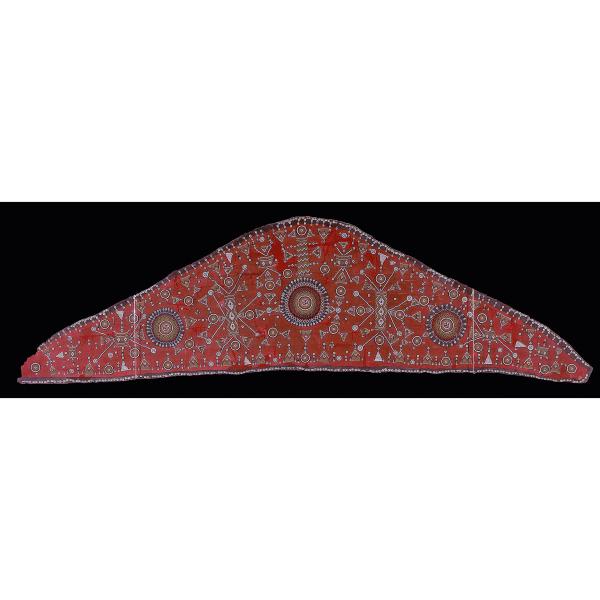
1558. Te saqwit (tent divider), Beja artists
Sumayya Vally
ANGELIQUE KIDJO (NARRATOR): This ornate architectural element served to both enhance and empower a Beja dwelling. It marked the threshold between spaces dedicated for daytime activities and those for night functions. Here is Sumayya Vally, South African architect.
SUMAYYA VALLY: In Beja settlements, the tent structures themselves were made under the leadership of a woman who was kind of head engineer. But then also the te saqwit itself was made by women, by relatives of a woman when she's about to be married, and this is really an act of love, an act of community, and symbolic of a woman entering into this threshold of a new chapter of her life.
It sits really at the boundary between welcoming community and forms of public life and keeping sacred forms of intimacy and privacy that happen behind the te saqwit. But it also, with the love and prayer that goes into making it, is seen to be something that keeps the spirit world from entering into the home and entering into the body of those that sleep around it.
ANGELIQUE KIDJO: It is an understanding of architecture that goes far beyond simply demarcating physical space.
SAMAYYA VALLY: So it has the functionality of the spiritual. And I find this non-colonial understanding of the term ‘functionality' really important, in that physical survival and spiritual function are completely intertwined.
More Artwork

Related Content
Publications
Books, guides, and catalogues published by The Met.
Research Resources
The Met provides unparalleled resources for research and welcomes an international community of students and scholars. The Met's Open Access API is where creators and researchers can connect to the The Met collection. Open Access data and public domain images are available for unrestricted commercial and noncommercial use without permission or fee.
To request images under copyright and other restrictions, please use this Image Request form.
Feedback
We continue to research and examine historical and cultural context for objects in The Met collection. If you have comments or questions about this object record, please contact us using the form below. The Museum looks forward to receiving your comments.
Content Notice
The Metropolitan Museum of Art presents over 5,000 years of art from around the world, and our online collection reflects ongoing work conducted over the course of our more than 150-year history. You may encounter objects or images that may be inappropriate for some viewers or information that may be outdated.