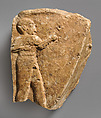
Relief fragment: siege of a city by Assyrian troops
Drawings from the nineteenth century excavations at Nineveh indicate the original location of this fragment in the Southwest Palace, Sennacherib’s (r. 704–681 B.C.) "Palace Without Rival," where it formed part of a military campaign taking place in a wooded and hilly country whose depiction probably filled the entire room. As was typical, the reliefs showed not only the sieges and military actions themselves but also their aftermath, with the taking of prisoners, livestock, and booty, and the counting of enemy soldiers’ heads – a common ancient approach to recording the casualties of battle. The reliefs are those of Sennacherib, the original builder of the palace, and are thought to depict events from his second major military campaign as king, in 702 B.C., which texts describe as taking place against multiple enemies in the central Zagros Mountains in western Iran. This area, and specifically the route through the mountains, was strategically important to the Assyrians as it controlled access to a key trade route east – what in later times would become known as the Great Khorasan Road.
Artwork Details
- Title: Relief fragment: siege of a city by Assyrian troops
- Period: Neo-Assyrian
- Date: ca. 704–681 BCE
- Geography: Mesopotamia, Nineveh
- Culture: Assyrian
- Medium: Gypsum alabaster
- Dimensions: 32 3/4 × 23 3/4 in. (83.2 × 60.3 cm)
- Credit Line: Gift of John D. Rockefeller Jr., 1932
- Object Number: 32.143.15
- Curatorial Department: Ancient West Asian Art
More Artwork
Research Resources
The Met provides unparalleled resources for research and welcomes an international community of students and scholars. The Met's Open Access API is where creators and researchers can connect to the The Met collection. Open Access data and public domain images are available for unrestricted commercial and noncommercial use without permission or fee.
To request images under copyright and other restrictions, please use this Image Request form.
Feedback
We continue to research and examine historical and cultural context for objects in The Met collection. If you have comments or questions about this object record, please contact us using the form below. The Museum looks forward to receiving your comments.
Content Notice
The Metropolitan Museum of Art presents over 5,000 years of art from around the world, and our online collection reflects ongoing work conducted over the course of our more than 150-year history. You may encounter objects or images that may be inappropriate for some viewers or information that may be outdated.