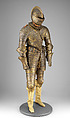
Armor with Matching Shaffron and Saddle Plates
It is the form worn by heavy cavalry throughout the sixteenth century, in which the wearer is covered from head to foot, and a lance rest is attached to the right side of the breastplate. Around 1600, however, lance-bearing heavy cavalry was being replaced by cuirassiers, heavy cavalry who were armored only to the knees and carried pistols and a sword. Features found here that are typical of the new cuirassier's armor are the close helmet with barred visor and falling buffe (face defense), the closed elbow joints, and the deep culet (skirt) attached the backplate.
Artwork Details
- Title: Armor with Matching Shaffron and Saddle Plates
- Date: ca. 1600
- Geography: Milan
- Culture: Italian, Milan
- Medium: Steel, copper alloy, silver, gold, leather, textile
- Dimensions: H. 62 5/8 in. (159.1 cm); Wt. 42 lb. 6 oz. (19.25 kg); 38.148.1m; H. 22 in. (55.9 cm); W. 11 1/2 in. (29.2 cm); 38.148.1n; H. 8 in. (20.3 cm); W. 12 1/4 in. (31.1 cm)
- Classification: Armor for Man
- Credit Line: Fletcher Fund, 1938
- Object Number: 38.148.1a–n
- Curatorial Department: Arms and Armor
Audio
4432. Armor with Matching Shaffron and Saddle Plates
NARRATOR: Take a close look at the delicate designs on this Milanese armor. They were created using several specialized techniques. Curator Pierre Terjanian.
PIERRE TERJANIAN: Other armors in these galleries are etched. And this one is done exclusively with engraving, and with what we call damascening. The technique for the decoration was to use sharp tools and engrave and incise the surface of the metal. And then, very carefully, silver and gold was applied to the surface after it had been scratched. It would just be applied and burnished and stay in place.
This armor, as you can see from its proportions, was not made for an adult. It was made for a boy, possibly about fifteen-years-old. An armor like this, which is beautifully forged, which is made of thick steel, would have been serviceable for war. But the likelihood is that an armor of this type for a young man would have been primarily used for practice, and for representational purposes. The idea being that a young prince, who has not yet reached the age of governing personally, is nevertheless signaling his position and his bright future to everyone by owning an armor that is of the quality of a ruling sovereign.
More Artwork
Related Content

Research Resources
The Met provides unparalleled resources for research and welcomes an international community of students and scholars. The Met's Open Access API is where creators and researchers can connect to the The Met collection. Open Access data and public domain images are available for unrestricted commercial and noncommercial use without permission or fee.
To request images under copyright and other restrictions, please use this Image Request form.
Feedback
We continue to research and examine historical and cultural context for objects in The Met collection. If you have comments or questions about this object record, please contact us using the form below. The Museum looks forward to receiving your comments.
Content Notice
The Metropolitan Museum of Art presents over 5,000 years of art from around the world, and our online collection reflects ongoing work conducted over the course of our more than 150-year history. You may encounter objects or images that may be inappropriate for some viewers or information that may be outdated.