Jacques-Louis Leblanc (1774–1846)
Artwork Details
- Title: Jacques-Louis Leblanc (1774–1846)
- Artist: Jean Auguste Dominique Ingres (French, Montauban 1780–1867 Paris)
- Date: 1823
- Medium: Oil on canvas
- Dimensions: 47 5/8 x 37 5/8 in. (121 x 95.6 cm)
- Classification: Paintings
- Credit Line: Catharine Lorillard Wolfe Collection, Wolfe Fund, 1918
- Object Number: 19.77.1
- Curatorial Department: European Paintings
Audio
6022. Jacques-Louis Leblanc (1774–1846)
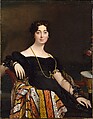
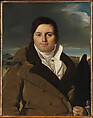
ASHER MILLER: We're looking at a pair of portraits by the French artist Jean-Auguste-Dominique Ingres, the standard bearer of the neoclassical style in the early 19th century. They depict Jacques-Louis Leblanc and his wife, the former Françoise Poncelle. Ingres described Monsieur Leblanc as “a Frenchman, very rich and also quite generous and good who has adopted us,” by which he meant to include his own wife, “and to the point of overwhelming us with kindness and also with requests for paintings, portraits, et cetera.”
KEITH CHRISTIANSEN: The Leblancs lived in Florence and they welcomed Ingres into their circle when he lived there during the 1820s.
ASHER MILLER: These portraits are not only about the sitters’ visages. Note how their heads stand out isolated against a blank background, while, in the lowest register we see what amounts to their attributes: furniture, still life, a book and so on. Madame Leblanc's casual elegance, the rhythm of her arms, echoed by her gold chain and even her coiffeur, are accentuated by the sense of restrained luxury. The paintings also exhibit the startlingly sharp illusionistic description for which Ingres is famous—as in Madame Leblanc's sheer silk sleeves and the rug on Monsieur Leblanc's table. The near symmetry of the pair and the way they're lit—above all the easy grace and the relative informality of the sitters—also convey much about their milieu, one with which the artist was on the most familiar terms.
KEITH CHRISTIANSEN: The great Impressionist painter artist Edgar Degas once owned these paintings and considered them to be among Ingres’s finest works. The Metropolitan acquired them at the posthumous sale of Degas’s collection in 1918.
More Artwork
Related Content

Research Resources
The Met provides unparalleled resources for research and welcomes an international community of students and scholars. The Met's Open Access API is where creators and researchers can connect to the The Met collection. Open Access data and public domain images are available for unrestricted commercial and noncommercial use without permission or fee.
To request images under copyright and other restrictions, please use this Image Request form.
Feedback
We continue to research and examine historical and cultural context for objects in The Met collection. If you have comments or questions about this object record, please contact us using the form below. The Museum looks forward to receiving your comments.
Content Notice
The Metropolitan Museum of Art presents over 5,000 years of art from around the world, and our online collection reflects ongoing work conducted over the course of our more than 150-year history. You may encounter objects or images that may be inappropriate for some viewers or information that may be outdated.