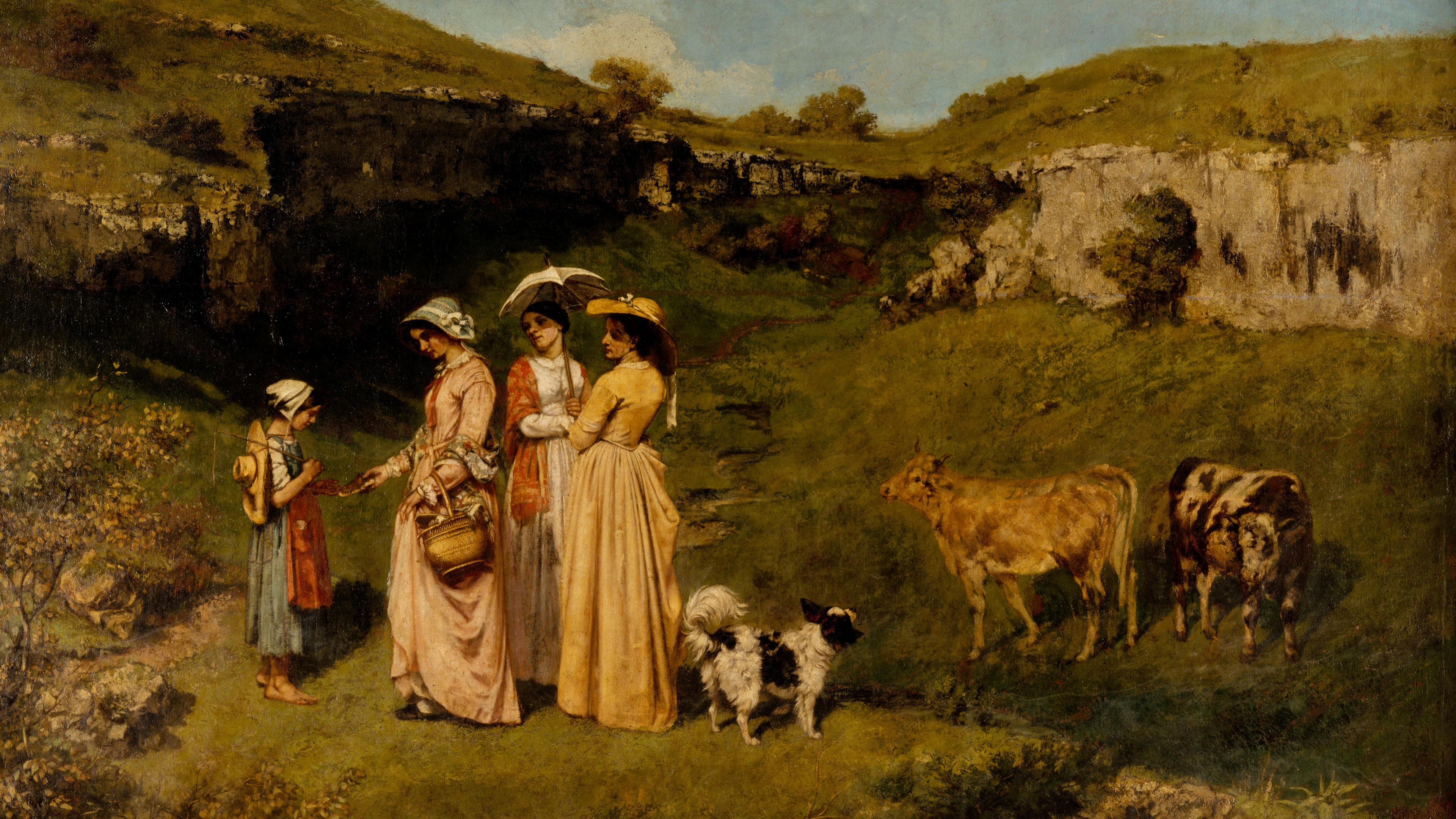
Young Ladies of the Village
This painting, which initiated a series of pictures devoted to the lives of women, shows Courbet’s three sisters—Zélie, Juliette, and Zoé—strolling in the Communal, a small valley near his native village of Ornans. One of the girls offers alms to a young cowherd. Courbet had high hopes for the work, but when it was exhibited at the Salon of 1852, critics attacked it as tasteless and clumsy. They reviled the models’ common features and countrified costumes, the "ridiculous" little dog and cattle, and the overall lack of unity, including traditional perspective and scale.
Artwork Details
- Title: Young Ladies of the Village
- Artist: Gustave Courbet (French, Ornans 1819–1877 La Tour-de-Peilz)
- Date: 1851–52
- Medium: Oil on canvas
- Dimensions: 76 3/4 x 102 3/4 in. (194.9 x 261 cm)
- Classification: Paintings
- Credit Line: Gift of Harry Payne Bingham, 1940
- Object Number: 40.175
- Curatorial Department: European Paintings
Audio
6102. Young Ladies of the Village
CHARLOTTE HALE: Courbet wrote to his parents, "It's impossible to tell you all the insults my painting of this year has won me." He continued, "But, I don't care, for when I'm no longer controversial, I'll no longer be important."
KEITH CHRISTIANSEN: To our eyes, it is hard to understand how Gustave Courbet’s painting could have provoked controversy, when it was first exhibited in 1852. But even the barking dog was decried as “ridiculous.” And the three young women—who were his sisters—were attacked for their common features and dress. Conservator Charlotte Hale:
CHARLOTTE HALE: They were wearing fancy clothes out in this quite wild landscape, and that was considered inappropriate. And it was also that people thought that they were jumped up country girls. The rules of decorum had been broken here. And Courbet knew it.
KEITH CHRISTIANSEN: Courbet chose as the subject of his art the landscape and people he knew—and he painted them with uncompromising directness, never seeking to prettify what he saw. In this, he flouted convention and he invited condemnation—even the disproportionately small cattle were attacked by critics.
CHARLOTTE HALE: We recently examined this painting. And x-rays showed us that he did actually enlarge them. And maybe you can see the original positions of their backs through the paint, which has become a bit more transparent over time. So, while he mocked his critics, it's possible that Courbet was more sensitive to their comments than he let on. In any case, Courbet's paintings of the experiences of ordinary people not only flouted the conventions of the Parisian art world. They changed the course of art history.
More Artwork
Related Content

Research Resources
The Met provides unparalleled resources for research and welcomes an international community of students and scholars. The Met's Open Access API is where creators and researchers can connect to the The Met collection. Open Access data and public domain images are available for unrestricted commercial and noncommercial use without permission or fee.
To request images under copyright and other restrictions, please use this Image Request form.
Feedback
We continue to research and examine historical and cultural context for objects in The Met collection. If you have comments or questions about this object record, please contact us using the form below. The Museum looks forward to receiving your comments.
Content Notice
The Metropolitan Museum of Art presents over 5,000 years of art from around the world, and our online collection reflects ongoing work conducted over the course of our more than 150-year history. You may encounter objects or images that may be inappropriate for some viewers or information that may be outdated.