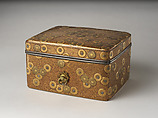
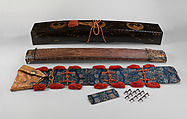
Writing Box with Cranes, Pines, Plum Blossoms, and Characters
Waka no ura ni
shiomichi kureba
kata o nami
ashibe o sashite
tazu naki-wataru
At Waka Bay
the tide flows in,
covering the sandbars,
as cranes fly toward
a bed of reeds, crying.
—Trans. John T. Carpenter
On the inside is an anonymous poem from the Kokinwakashū anthology. The plover’s chirp is said to sound like “chiyo,” as contained in the phrase “eight thousand years” (ya-chiyo):
Shio no yama
sashide no iso ni
sumu chidori
kimi ga miyo oba
yachiyo to zo naku
Plovers that dwell
on the beach of Sashide,
nearby Mount Shio,
chirp “ya-chiyo,” wishing
the emperor a long reign.
—Trans. John T. Carpenter
Artwork Details
- 鶴松梅文字散し蒔絵硯箱
- Title: Writing Box with Cranes, Pines, Plum Blossoms, and Characters
- Period: Edo period (1615–1868)
- Date: 18th century
- Culture: Japan
- Medium: Lacquered wood with gold and silver takamaki-e, hiramaki-e, togidashimaki-e, and silver inlay on nashiji ground
- Dimensions: H. 1 7/8 in. (4.8 cm); W. 8 3/4 in. (22.2 cm); D. 9 1/2 in. (24.1 cm)
- Classification: Lacquer
- Credit Line: Bequest of Benjamin Altman, 1913
- Object Number: 14.40.831a–f
- Curatorial Department: Asian Art
More Artwork
Research Resources
The Met provides unparalleled resources for research and welcomes an international community of students and scholars. The Met's Open Access API is where creators and researchers can connect to the The Met collection. Open Access data and public domain images are available for unrestricted commercial and noncommercial use without permission or fee.
To request images under copyright and other restrictions, please use this Image Request form.
Feedback
We continue to research and examine historical and cultural context for objects in The Met collection. If you have comments or questions about this object record, please contact us using the form below. The Museum looks forward to receiving your comments.
Content Notice
The Metropolitan Museum of Art presents over 5,000 years of art from around the world, and our online collection reflects ongoing work conducted over the course of our more than 150-year history. You may encounter objects or images that may be inappropriate for some viewers or information that may be outdated.