English
DonateMembershipTickets

Barrel-shaped planter with Chinese figures

ca. 1760
Not on view
The production of a distinctive Chinese-inspired style of tin-glazed earthenware was already well established in the city of Puebla de los Angeles when, in 1682, the ordinances of its potter's guild were revised to reflect existing practice. One new clause stipulated that the painting of fine ware (loza fina) "must imitate that of China" and be done in blue. The guild ordinances document not only the explicit intent to imitate Chinese porcelain, but the professional resolve to control and authorize material aspects of the process, thereby identifying decoration in blue as its defining trait. Puebla potters also copied the distinctive shapes of Chinese porcelain. The barrel-shaped form of this large, thickly potted earthenware planter is reminiscent of ceramic garden seats. Its blue-and-white ornamentation is likewise inspired by imported porcelain, while its figural decoration, which conjures four Chinese types or occupations, is indebted to European Chinoiserie.The fanciful figures are separated by four pendant lappets in blue wih floral sprays in white reserve. The outlandish dress of the barefooted figures--a musician, a dancer, a merchant, and a mariner--markes them as "foreign," if not specifically Chinese in every instance. The ethnicity of the mariner, who brandishes a navigation compass and peers through a telescope, is more ambiguous than the other three figures. Such imprecision is consistent with the tendency in New Spain to identify nearly all Asians (and Asian goods), regardless of their exact origin, as "Chinesee." Characterized as entertainers and maritime traders, their representation on a flowerpot all but assures that they were read as amusing or even comical figures, well-suited for the adornment of a garden or place of recreation.

--Ronda Kasl

Artwork Details

Object Information
  • Title: Barrel-shaped planter with Chinese figures
  • Date: ca. 1760
  • Geography: Made in Mexico
  • Culture: Mexican
  • Medium: Tin-glazed earthenware
  • Dimensions: H. 18 in. (45.7 cm)
  • Credit Line: Gift of Mrs. Robert W. de Forest, 1911
  • Object Number: 11.87.41
  • Curatorial Department: The American Wing
More Artwork
The Marriage of the Virgin, José Sánchez  Mexican, Oil on canvas, Mexican
José Sánchez
ca. 1690
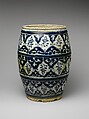
Barrel, Tin-glazed earthenware, Mexican
Mexican
ca. 1700–1750
Print dedicated to Juan Antonio Vizarrón y Eguiarreta, Archbishop of Mexico and Viceroy of New Spain, Juan Antonio Vizarrón y Eguiarreta  Spanish, Woodcut printed on pink silk with a red border
Dedicatee Juan Antonio Vizarrón y Eguiarreta
Publisher José Bernardo de Hogal
ca. 1730–40
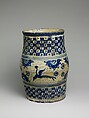
Barrel, Tin-glazed earthenware, Mexican
Mexican
ca. 1750–1800
Thesis Proclamation of José Vicente Maldonado y Trespalacios, dedicated to the Virgin of Guadalupe, Baltasar Troncoso y Sotomayor  Mexican, Woodcut, letterpress and engraving (image of the Virgin) printed on white silk with a decorative metalic thread border backed with a panel of red silk.
Baltasar Troncoso y Sotomayor
Publisher Herederos de María de Rivera
1756

Research Resources

The Met provides unparalleled resources for research and welcomes an international community of students and scholars. The Met's Open Access API is where creators and researchers can connect to the The Met collection. Open Access data and public domain images are available for unrestricted commercial and noncommercial use without permission or fee.

To request images under copyright and other restrictions, please use this Image Request form.

Feedback

We continue to research and examine historical and cultural context for objects in The Met collection. If you have comments or questions about this object record, please contact us using the form below. The Museum looks forward to receiving your comments.

Send feedback

Content Notice

The Metropolitan Museum of Art presents over 5,000 years of art from around the world, and our online collection reflects ongoing work conducted over the course of our more than 150-year history. You may encounter objects or images that may be inappropriate for some viewers or information that may be outdated.