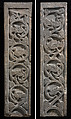
Pilaster of Angels Sounding Trumpets from the Parapet of a Pulpit
Artwork Details
- Title: Pilaster of Angels Sounding Trumpets from the Parapet of a Pulpit
- Artist: Workshop of Giovanni Pisano (Italian, Pisa ca. 1240–before 1320 Siena)
- Date: 1302–10
- Geography: Made in Pisa, Tuscany, Italy
- Culture: Central Italian
- Medium: Marble (Lunense from Carrara), traces of paint
- Dimensions: 33 1/2 × 7 1/8 × 6 1/2 in., 64 lb. (85.1 × 18.1 × 16.5 cm, 29 kg)
- Classification: Sculpture-Stone
- Credit Line: Frederick C. Hewitt Fund, 1910
- Object Number: 10.203.1
- Curatorial Department: Medieval Art and The Cloisters
Audio
84. Body Language: Curators and Theater Director: Pilaster of Angels Sounding Trumpets, Part 1
Gallery 305
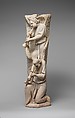
PETER BARNET: We know the artist who carved the pulpit in Pisa: Giovanni Pisano, one of the most famous artists of the Middle Ages. And he's known for a very theatrical style; and I think you can see something of that here. It's the puffed-out cheeks, exaggerated poses. You can see that he's used a drill in the hair in some cases to create deep shadows and so forth.
GRIFFITH MANN: The other thing that the sculptor has done is really twisted the forms of the two angels as they're stacked one on top of each other, so that their bodies turn in different poses and positions. There is this tremendous spiraling sense of animation that's been given to the group as a result.
PETER BARNET: I think it's important with all sculptures and works of art, when possible, to try to have a sense of their original context, and this context certainly was a very public one in the middle of one of the great cathedrals of Europe. And it was a very large space, perhaps not very well lit. Broad gestures and theatricality were an effort to make sure the figures could be seen and read from a distance.
NARRATOR: Hear cellist and composer Joan Jeanrenaud respond to this sculpture in music. Press PLAY.
Listen to more about this artwork
More Artwork
Related Content
Publications
Books, guides, and catalogues published by The Met.
Research Resources
The Met provides unparalleled resources for research and welcomes an international community of students and scholars. The Met's Open Access API is where creators and researchers can connect to the The Met collection. Open Access data and public domain images are available for unrestricted commercial and noncommercial use without permission or fee.
To request images under copyright and other restrictions, please use this Image Request form.
Feedback
We continue to research and examine historical and cultural context for objects in The Met collection. If you have comments or questions about this object record, please contact us using the form below. The Museum looks forward to receiving your comments.
Content Notice
The Metropolitan Museum of Art presents over 5,000 years of art from around the world, and our online collection reflects ongoing work conducted over the course of our more than 150-year history. You may encounter objects or images that may be inappropriate for some viewers or information that may be outdated.