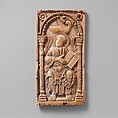
Plaque with the Virgin Mary as a Personification of the Church
Artwork Details
- Title: Plaque with the Virgin Mary as a Personification of the Church
- Date: ca. 800–825
- Geography: Made in Aachen, Germany
- Culture: Carolingian
- Medium: Elephant ivory
- Dimensions: Overall: 8 11/16 x 5 11/16 x 5/16 in. (22 x 14.5 x 0.8 cm)
- Classification: Ivories-Elephant
- Credit Line: Gift of J. Pierpont Morgan, 1917
- Object Number: 17.190.49
- Curatorial Department: Medieval Art and The Cloisters
Audio
2955. Plaque with the Virgin Mary as a Personifixation of the Church
Surprisingly, this militaristic image is a depiction of the Virgin Mary. She sits on an elaborately carved throne, her arms bent as if ready for action. Indeed, this type of image refers to her role as protector of the church. But the prominent halo and long, cross-topped scepter reveal her divine nature. The spindles in her other hand provide another, more subtle clue. They refer to the veil she was weaving at the moment of the Annunciation, when the Archangel Gabriel informs her that she will be the mother of Christ. Look at other details… The intricate pattern lining the edges of the tablet is what is known as an egg and dart motif. This decorative embellishment first appeared on Classical monuments, and was greatly admired and copied in the Middle Ages. On the upper right and left corners, peacocks serve as symbolic references to the resurrection of Christ.
This ivory plaque was carved in the early 800s during the Carolingian period—the age of Charlemagne. Crowned emperor in Rome on Christmas day of the year 800, Charlemagne consolidated vast areas of Europe into his powerful empire. Although the original function of this plaque is uncertain, the holes in the corners suggest that it may have decorated a book cover.
More Artwork
Related Content
 Free to download
Research Resources
The Met provides unparalleled resources for research and welcomes an international community of students and scholars. The Met's Open Access API is where creators and researchers can connect to the The Met collection. Open Access data and public domain images are available for unrestricted commercial and noncommercial use without permission or fee.
To request images under copyright and other restrictions, please use this Image Request form.
Feedback
We continue to research and examine historical and cultural context for objects in The Met collection. If you have comments or questions about this object record, please contact us using the form below. The Museum looks forward to receiving your comments.
Content Notice
The Metropolitan Museum of Art presents over 5,000 years of art from around the world, and our online collection reflects ongoing work conducted over the course of our more than 150-year history. You may encounter objects or images that may be inappropriate for some viewers or information that may be outdated.