Saint Paul
Artwork Details
- Title: Saint Paul
- Artist: Circle of Claus de Werve (Netherlandish, active in France, ca. 1380–1439, active Burgundy, 1396–ca. 1439)
- Date: ca. 1420–30
- Geography: Made in Poligny, Burgundy, France
- Culture: French
- Medium: Limestone with traces of paint
- Dimensions: Overall: 47 1/4 x 25 1/2 x 12 in. (120 x 64.8 x 30.5 cm)
- Classification: Sculpture-Stone
- Credit Line: Mrs. Stephen V. Harkness Fund, 1922
- Object Number: 22.31.1
- Curatorial Department: Medieval Art and The Cloisters
Audio
85. Body Language: Curators and Theater Director: Saint Paul, Part 1
Gallery 305
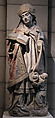
NARRATOR: Look carefully at the position of Saint Paul's head.
GRIFFITH MANN: The slight tilting of his head helps to create that sense that there is a kind of living presence. You know, you tilt your head when you're engaged in conversation, when you're thinking. And at the same time, the gaze is so steady, penetrating. There's something resolute and committed in the way that he looks out from his position.
NARRATOR: The pose also provides clues to the sculpture's original setting in a family chapel in Burgundy.
GRIFFITH MANN: He is sort of leaning out a little bit. The inclined head not only gives you a sense of mental presence, but also makes the face more visible for anyone looking at this sculpture from the ground. In fact, he probably was part of a larger architectural ensemble that would have been presented high above our heads.
NARRATOR: Hear cellist and composer Joan Jeanrenaud respond to this sculpture in music. Press PLAY.
Listen to more about this artwork
More Artwork
Related Content
 Free to download
Research Resources
The Met provides unparalleled resources for research and welcomes an international community of students and scholars. The Met's Open Access API is where creators and researchers can connect to the The Met collection. Open Access data and public domain images are available for unrestricted commercial and noncommercial use without permission or fee.
To request images under copyright and other restrictions, please use this Image Request form.
Feedback
We continue to research and examine historical and cultural context for objects in The Met collection. If you have comments or questions about this object record, please contact us using the form below. The Museum looks forward to receiving your comments.
Content Notice
The Metropolitan Museum of Art presents over 5,000 years of art from around the world, and our online collection reflects ongoing work conducted over the course of our more than 150-year history. You may encounter objects or images that may be inappropriate for some viewers or information that may be outdated.