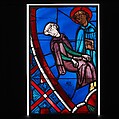
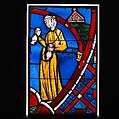
Scenes from the Legend of Saint Vincent of Saragossa and the History of His Relics
Like the contemporary, famous windows of Louis IX’s royal chapel, Sainte-Chapelle, these panels make it clear that by the middle of the thirteenth century Paris was the leading center for a new, expressive style of glass painting.
Artwork Details
- Title: Scenes from the Legend of Saint Vincent of Saragossa and the History of His Relics
- Date: ca. 1245–47
- Geography: Made in Paris, France
- Culture: French
- Medium: Pot-metal glass, vitreous paint, and lead
- Dimensions: Overall: 147 x 43 1/2in. (373.4 x 110.5cm)
Overall (Installation Opening): 144 x 41 1/2 in. (365.8 x 105.4 cm) - Classification: Glass-Stained
- Credit Line: Gift of George D. Pratt, 1924
- Object Number: 24.167a-k
- Curatorial Department: Medieval Art and The Cloisters
Audio
2995. Scenes from the Legend of Saint Vincent of Saragossa and the History of His Relics
NARRATOR: This vibrantly colored thirteenth-century window tells the story of the martyred Saint Vincent of Saragossa. In the upper left, you can see St. Vincent wrapped up in a net, as two men lower him over the side of a boat and into the sea. The two men on horseback are a King and his brother, carrying the precious relics of the martyr back to Paris. There they were ultimately housed in the abbey of St. Germain des Prés, the original site of this window.
The scenes are not installed in their original order. In fact, they were part of two or more windows, joined here to make a single, composite window. Curator Timothy Husband.
TIMOTHY HUSBAND: These windows had to be simple, uncluttered compositions so that people in the nave of the church could readily recognize the figures and understand the narrative. The windows produced by the so-called Court School of Paris in the middle of the thirteenth century are remarkable for the legibility of their narratives. And in part this depends on the optical qualities of the very colors they used. Blue and red were favorite colors in their palette because of the recessive and projecting qualities. The blue recedes, and the red visually projects. And when the narrative scenes were placed against it, the scene itself projected forward from the background making it visually more clear.
Listen to more about this artwork
More Artwork
Research Resources
The Met provides unparalleled resources for research and welcomes an international community of students and scholars. The Met's Open Access API is where creators and researchers can connect to the The Met collection. Open Access data and public domain images are available for unrestricted commercial and noncommercial use without permission or fee.
To request images under copyright and other restrictions, please use this Image Request form.
Feedback
We continue to research and examine historical and cultural context for objects in The Met collection. If you have comments or questions about this object record, please contact us using the form below. The Museum looks forward to receiving your comments.