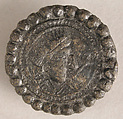
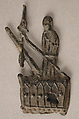
Pilgrim's Badge of the Shrine of St. Thomas Becket at Canterbury
Artwork Details
- Title: Pilgrim's Badge of the Shrine of St. Thomas Becket at Canterbury
- Date: 1350–1400
- Geography: Made in Canterbury, England
- Culture: British
- Medium: Cast tin-lead alloy
- Dimensions: Overall: 3 1/8 x 2 1/2 x 1/8in. (7.9 x 6.4 x 0.3cm)
- Classification: Metalwork-Pewter
- Credit Line: Gift of Dr. and Mrs. W. Conte, 2001
- Object Number: 2001.310
- Curatorial Department: Medieval Art and The Cloisters
Audio
3115. Pilgrim's Badge of the Shrine of St. Thomas Becket at Canterbury
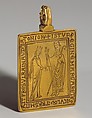
NARRATOR: All of the objects in this case relate to the martyrdom of St. Thomas Becket. Here we see luxury objects—an ivory comb, a gold locket that once contained his blood, and a small casket-shaped reliquary depicting his martyrdom. Popular objects are represented by the fragment of a metal pilgrim’s badge from his shrine.
Becket was a celebrated archbishop of the twelfth century. He was infamously murdered in Canterbury Cathedral for professing greater allegiance to the church than to the King of England. After his death, throngs of pilgrims flooded the Cathedral from all over Europe, transforming it into a shrine. On the right of the badge, a figure raises the cover of the shrine to reveal Becket’s elaborate tomb effigy. There, the Saint is depicted in a mitre, or bishop’s hat. A small figure above him points to a ruby, believed to be the largest in existence at the time. Testament to his importance, Becket’s shrine was an opulent creation made of gold and jewels, and surmounted by an elaborate canopy. When it was melted down during the Reformation—on the orders of King Henry VIII—over twenty five cartloads of gold and silver were taken away. Curator Charles Little.
CHARLES LITTLE: The devotion to him was extraordinarily wide spread and very much today as we might see the assassination of a President like John F. Kennedy in terms of the almost cultic interest in his power.
More Artwork
Related Content

 Free to download
Research Resources
The Met provides unparalleled resources for research and welcomes an international community of students and scholars. The Met's Open Access API is where creators and researchers can connect to the The Met collection. Open Access data and public domain images are available for unrestricted commercial and noncommercial use without permission or fee.
To request images under copyright and other restrictions, please use this Image Request form.
Feedback
We continue to research and examine historical and cultural context for objects in The Met collection. If you have comments or questions about this object record, please contact us using the form below. The Museum looks forward to receiving your comments.
Content Notice
The Metropolitan Museum of Art presents over 5,000 years of art from around the world, and our online collection reflects ongoing work conducted over the course of our more than 150-year history. You may encounter objects or images that may be inappropriate for some viewers or information that may be outdated.