Male figure
The figure’s upper garment hangs from a thin thread over his right shoulder. His tall, peaked cap is woven in a geometric design and banded with rolls of clay representing cloth twisted to form a diagonal pattern. Few textiles from ancient Mesoamerica have survived, but artworks such as this one provide valuable insights into their use and appearance. West Mexico’s weavers utilized various structural techniques on and off the loom to create designs that reflect the geometry of the weaving process itself. Cloth, colored with dyes sourced from plants, insects, and minerals was manipulated in myriad ways to create items of dress and ornament. As seen on this figure, textiles were wrapped around the lower body to form loincloths, and narrow, twisted bands of cloth were wound and tied to secure head coverings.
While created as one of a male/female pair, matched in size and body position and wearing complementary clothing, jewelry, and body ornamentation, this figure’s gender is nonetheless clearly indicated. He wears a loincloth, and holds what may be a staff or weapon, likely a sign of his position within the community. Such pairs may represent ancestors, or the persons buried in the tombs where they were placed. They may also stand in for the primordial couple, the origin of life itself. As such, they suggest a broader cosmic view, rooted in duality and the balance of opposites.
Patricia J. Sarro, 2024
Further Reading
Baumbach, Otto Schöndube. EL HORIZONTE CLASICO: Las Culturas de Jalisco, Colima y Nayarit / THE CLASSIC HORIZON: The Cultures of Colima, Jalisco, and Nayarit. Artes de México, no. 119 (1969): 23–68. http://www.jstor.org/stable/24315718.
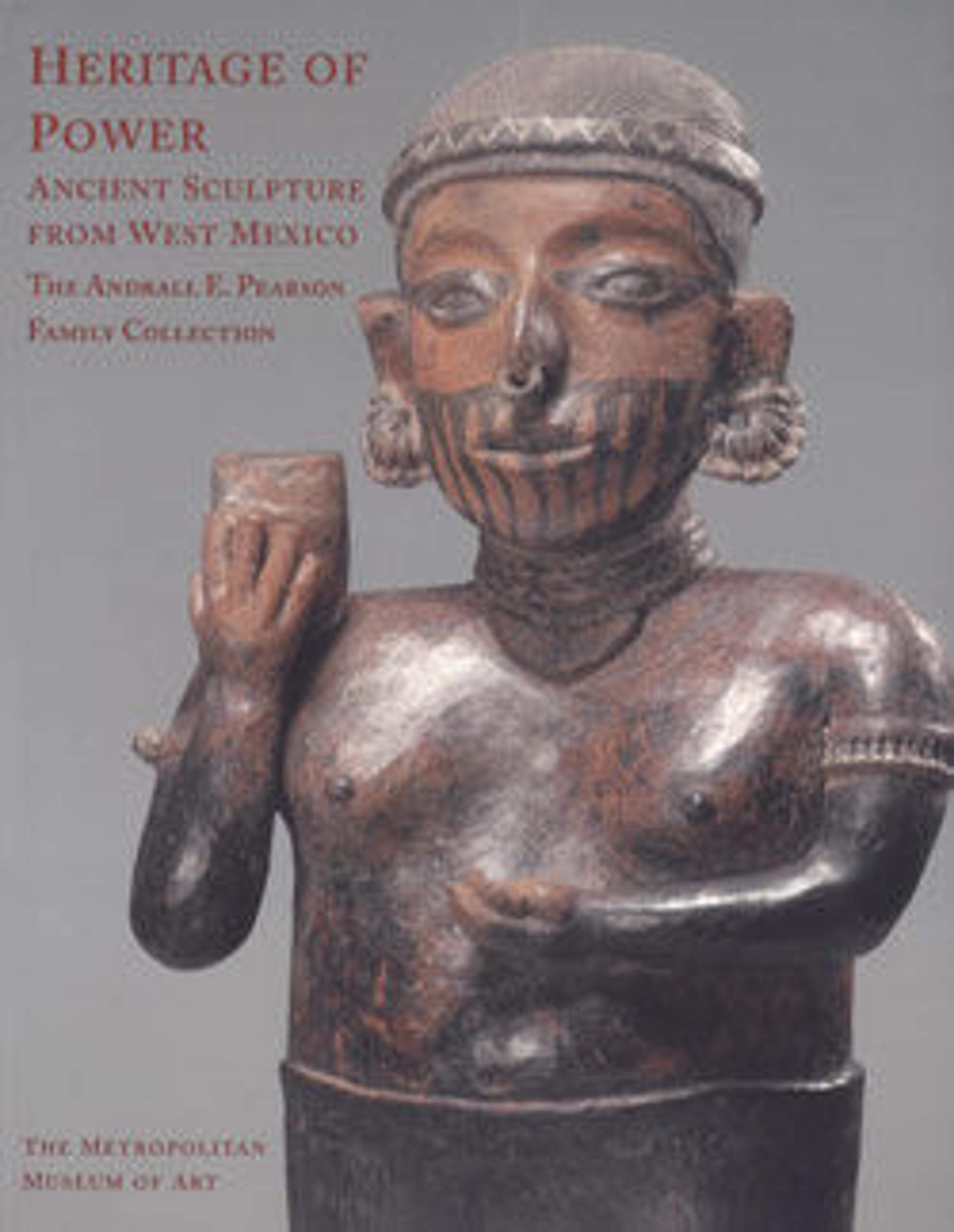
Butterwick, Kristi. Heritage of Power: Ancient Sculpture from West Mexico: The Andrall E. Pearson Family Collection. New York, New Haven, London: The Metropolitan Museum of Art, 2004, pp. 85–86, no. 38.
Cabrero G., Ma. Teresa and Carlos López Cruz. Las Tumbas de tiro de El Piñon, En El Cañon de Bolaños, Jalisco, Mexico. Latin American Antiquity 9, no. 4 (1998): 328–41. https://doi.org/10.2307/3537031.
Gallagher, Jacki. Companions of the Dead. Ceramic Tomb Sculpture from Ancient West Mexico. Los Angeles: University of California. 1983.
Los Angeles County Museum of Art. Sculpture of Ancient West Mexico, Nayarit, Jalisco, Colima. Los Angeles: The Los Angeles County Museum of Art, 1989.
Pickering, Robert B., and Ephraim Cuevas. The Ancient Ceramics of West Mexico: Corpse-Eating Insects and Mineral Stains Help a Forensic Anthropologist and a Chemist Determine the Authenticity of 2,000-Year-Old Figurines. American Scientist 91, no. 3 (2003): 242–49. http://www.jstor.org/stable/27858214.
Pickering, Robert B. and Cheryl Smallwood-Roberts. West Mexico: ritual and identity. Tulsa: Gilcrease Museum, 2016
Townsend, Richard, ed. Ancient West Mexico: Art and Archaeology of the Unknown Past. Chicago: Art Institute of Chicago, 1998.
Zepeda, Gabriela, Nayarit prehispánico. In Introducción a la arqueología del Occidente de México. Mexico City: Instituto Nacional de Antropología e Historia: 2004, pp. 371-396.
Artwork Details
- Title: Male figure
- Artist: Ixtlán del Río artist(s)
- Date: 200 BCE–200 CE
- Geography: Mexico, Mesoamerica, Nayarit
- Culture: Nayarit
- Medium: Ceramic, slip
- Dimensions: H. 21 1/2 × W. 8 5/8 × D. 6 7/8 in. (54.6 × 21.9 × 17.5 cm)
- Classification: Ceramics-Sculpture
- Credit Line: Gift of Jill and Alan Rappaport, 2005
- Object Number: 2005.255.2
- Curatorial Department: The Michael C. Rockefeller Wing
More Artwork
Related Content

 Free to download
Research Resources
The Met provides unparalleled resources for research and welcomes an international community of students and scholars. The Met's Open Access API is where creators and researchers can connect to the The Met collection. Open Access data and public domain images are available for unrestricted commercial and noncommercial use without permission or fee.
To request images under copyright and other restrictions, please use this Image Request form.
Feedback
We continue to research and examine historical and cultural context for objects in The Met collection. If you have comments or questions about this object record, please contact us using the form below. The Museum looks forward to receiving your comments.
Content Notice
The Metropolitan Museum of Art presents over 5,000 years of art from around the world, and our online collection reflects ongoing work conducted over the course of our more than 150-year history. You may encounter objects or images that may be inappropriate for some viewers or information that may be outdated.