Village scene
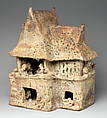
There is no indication of hierarchy among the village inhabitants, although gender and age are clearly distinguished. Of the seven dancers, all adults, three are female; they wear only skirts, and their breasts are clearly depicted. The other four are male, each wearing turban-like headdress. Three pairs of figures and one small individual are placed irregularly around them, suggesting a spontaneous gathering. To the right of the small structure, an adult couple looks on, wrapped together in a single blanket. Two pairs of children, leaning casually on one another, watch from the opposite side. Another child stands just outside the circle, directly across from the small building. He places his hands on the arms of two of the dancers, as if hoping he will be allowed to join them.
Nayarit art celebrates the connections between individuals, and among community members. Male and female figurines representing ancestors or village leaders were often created as pairs, complementary in size and dress (see MMA 2005.255.2, 3). Narrative models depict the wider community at elaborate feasts (see MMA 1979.206.359, 2015.306), playing and observing the ballgame, or engaged in a ritual activity such as the one seen here. These scenes are highly animated, with various figures often touching and gesturing in conversation.
The hand of the artist is evident in the completed work. Each figure was formed individually. Where the artist joined the dancers together, their hands have been flattened as the artist pressed the hand of one figure onto the back of another. The blanket wrapped around two of the watchers, as well as the skirts of the female dancers, were formed by wrapping thick, flat pieces of clay around them. Much of the paint has faded over time, but red, black and cream striations can be detected on clothing, the building roof and walls, and the floor of the plaza.
Patricia J. Sarro, 2023
Further Reading
Butterwick, Kristi. Heritage of Power: Ancient Sculpture From West Mexico: The Andrall E. Pearson Family Collection. New York, New Haven, London: The Metropolitan Museum of Art, 2004.
Hers, Marie-Areti, ed. Miradas renovadas al Occidente indígena de México. Mexico: Universidad Autónoma de México, 2013.
Pillsbury, Joanne, Patricia Joan Sarro, James Doyle, and Juliet Wiersema. Design for Eternity: Architectural Models from the Ancient Americas. New York: The Metropolitan Museum of Art, 2015, pp. 36–37, figs. 35–37.
Schávelzon, Daniel. Treinta siglos de imágenes: maquetas y representaciones de arquitectura en México y América Central prehispánica. Buenos Aires: Fundación Centro de Estudios para Políticas Públicas Aplicadas, 2004, p. 121.
Townsend, Richard F., ed. Ancient West Mexico: Art and Archaeology of the Unknown Past. Chicago, Art Institute of America, 1998. von Winning, Hasso. Anecdotal Sculpture of Ancient West Mexico. Los Angeles: Ethnic Arts Council of Los Angeles, 1972, no. 28, p. 54.
Artwork Details
- Title: Village scene
- Artist: Nayarit artist(s)
- Date: 300 BCE–300 CE
- Geography: Mexico, West Mexico, Nayarit
- Culture: Nayarit
- Medium: Ceramic, slip
- Dimensions: H. 6 1/4 × Diam. 8 in. (15.9 × 20.3 cm)
- Classification: Ceramics-Sculpture
- Credit Line: From the Collection of Nina and Gordon Bunshaft, Bequest of Nina Bunshaft, 1994
- Object Number: 1995.63.4
- Curatorial Department: The Michael C. Rockefeller Wing
More Artwork
Related Content


Research Resources
The Met provides unparalleled resources for research and welcomes an international community of students and scholars. The Met's Open Access API is where creators and researchers can connect to the The Met collection. Open Access data and public domain images are available for unrestricted commercial and noncommercial use without permission or fee.
To request images under copyright and other restrictions, please use this Image Request form.
Feedback
We continue to research and examine historical and cultural context for objects in The Met collection. If you have comments or questions about this object record, please contact us using the form below. The Museum looks forward to receiving your comments.
Content Notice
The Metropolitan Museum of Art presents over 5,000 years of art from around the world, and our online collection reflects ongoing work conducted over the course of our more than 150-year history. You may encounter objects or images that may be inappropriate for some viewers or information that may be outdated.