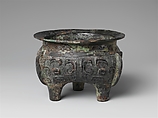
Lobed Tripod Cauldron (Liding)
Artwork Details
- 商 青銅鬲鼎
- Title: Lobed Tripod Cauldron (Liding)
- Period: Shang dynasty (ca. 1600–1046 BCE)
- Date: 12th–11th century BCE
- Culture: China
- Medium: Bronze
- Dimensions: H. to handles 7 1/2 in. (19.1 cm); H. at rim 6 1/4 in. (15.9 cm); W. at handles 5 3/4 in. (14.6 cm)
- Classification: Metalwork
- Credit Line: Gift of Mrs. John Marriott, Mrs. John Barry Ryan, Gilbert W. Kahn, and Roger Wolfe Kahn, 1949
- Object Number: 49.136.5
- Curatorial Department: Asian Art
Audio
7350. Ritual Lobed Tripod Cauldron (Liding)
[GONGS PLAYING]
The two vessels at the rear of this case illustrate the aesthetic changes that accompanied the transition from ceramics to bronze during China’s early Bronze Age, from about 1600 to 1100 BC. During that period, the forms of ceramics were adapted, reinterpreted, and cast into metal.
The earthenware tripod on the right is organic in shape; sprouting directly from its round top are bulbous legs that taper radically to narrow endings. The three-legged, bronze ritual vessel on the left is more structured and architectural, with a geometrical body and columnar legs. This piece, known as a li, contained food offerings for use in rituals connected with ancestor worship.
Because early Chinese bronze vessels were cast from pottery molds, their manufacture drew upon many of the same technologies employed in making ceramics. Nevertheless, the architectonic forms of these bronzes reflect the tensile strength of metal.
More Artwork
Related Content
 Free to download
Research Resources
The Met provides unparalleled resources for research and welcomes an international community of students and scholars. The Met's Open Access API is where creators and researchers can connect to the The Met collection. Open Access data and public domain images are available for unrestricted commercial and noncommercial use without permission or fee.
To request images under copyright and other restrictions, please use this Image Request form.
Feedback
We continue to research and examine historical and cultural context for objects in The Met collection. If you have comments or questions about this object record, please contact us using the form below. The Museum looks forward to receiving your comments.
Content Notice
The Metropolitan Museum of Art presents over 5,000 years of art from around the world, and our online collection reflects ongoing work conducted over the course of our more than 150-year history. You may encounter objects or images that may be inappropriate for some viewers or information that may be outdated.