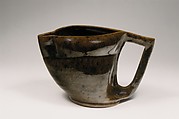
Pitcher
Artwork Details
- Title: Pitcher
- Maker: George E. Ohr (American, Biloxi, Mississippi 1857–1918 Biloxi, Mississippi)
- Manufacturer: Biloxi Art Pottery (1883–1906)
- Date: ca. 1893–1909
- Geography: Made in Biloxi, Mississippi, United States
- Culture: American
- Medium: Earthenware
- Dimensions: Other: 5 × 6 in. (12.7 × 15.2 cm)
- Credit Line: Gift of Florence I. Balasny-Barnes, in honor of her brother, Raymond L. Balasny, and children, Susan, Jill and Neal, 1981
- Object Number: 1981.432.1
- Curatorial Department: The American Wing
Audio
4535. Pitcher
MORRISON HECKSCHER: At this case, curator Alice Cooney Frelinghuysen is talking with Robert Ellison, who promised, as a gift, all the pottery in this mezzanine. George Ohr is one of his favorite potters.
ROBERT ELLISON: Well, he's an anomaly within this period. He did things that nobody did. At the time, everybody thought Ohr was, like, a joker and was trying to get attention, so they didn't take it seriously, and he had no followers to carry on; he didn't influence anybody. So… when he died, in a sense, his work died.
ALICE COONEY FRELINGHUYSEN: They're incredibly light, they're featherweight, very, very thinly potted… you can actually see where his fingers have punched in these pieces, twisted it, but highly controlled. It's extraordinary when you think of how thin these walls were; the control that he was able to achieve.
ROBERT ELLISON: Well, even his contemporaries had to admit he was a fantastic thrower, and they did like his glazes, but they thought he was torturing his forms.
ALICE COONEY FRELINGHUYSEN: It wasn't really until, what, the early 1970s that…
ROBERT ELLISON: … the early '70s. And at that time, contemporary potters started taking notice and so he had a degree of influence in the last quarter of the 20th century.
ALICE COONEY FRELINGHUYSEN: Contemporary artists, too, Jasper Johns and others were very…
ROBERT ELLISON: Yes, fine artists liked it, the potters liked it. He often said, well, you know, what I'm doing is something informed. And some day you'll appreciate it. And so it remained for a bunch of us in this last quarter of the 20th century to confirm that George Ohr actually knew what he was doing.
More Artwork
Related Content
 Free to download
Research Resources
The Met provides unparalleled resources for research and welcomes an international community of students and scholars. The Met's Open Access API is where creators and researchers can connect to the The Met collection. Open Access data and public domain images are available for unrestricted commercial and noncommercial use without permission or fee.
To request images under copyright and other restrictions, please use this Image Request form.
Feedback
We continue to research and examine historical and cultural context for objects in The Met collection. If you have comments or questions about this object record, please contact us using the form below. The Museum looks forward to receiving your comments.
Content Notice
The Metropolitan Museum of Art presents over 5,000 years of art from around the world, and our online collection reflects ongoing work conducted over the course of our more than 150-year history. You may encounter objects or images that may be inappropriate for some viewers or information that may be outdated.