Copper alloy chisel
Seán Hemingway
(1) A slightly smaller but comparable example, which is dated to the Early Cycladic II period but also lacks an archaeological context, exists in the Museum of Cycladic Art in Athens, inv. no. NG0224. See Museum of Cycladic Art: Highlights (Athens 2023), pp. 112-113, no. 52. On Cycladic Early Bronze Age metalwork, see K. Branigan, Aegean Metalwork of the Early and Middle Bronze Age (Oxford: Clarendon Press, 1974), pp. 24-26, pls. 14-15.
Artwork Details
- Title: Copper alloy chisel
- Period: Early Cycladic II
- Date: ca. 2700–2400/2300 BCE
- Culture: Cycladic
- Medium: Copper alloy
- Dimensions: Height: 1 5/16 in. (3.4 cm)
Width: 1 5/16 in. (3.4 cm)
Length: 9 5/16 in. (23.7 cm)
Thickness: 15/16 in. (2.4 cm)
Weight: 38.44 oz. (1090 g) - Classification: Bronzes
- Credit Line: Leonard N. Stern Collection, Loan from the Hellenic Republic, Ministry of Culture
- Object Number: L.2022.38.100
- Curatorial Department: Greek and Roman Art
Audio
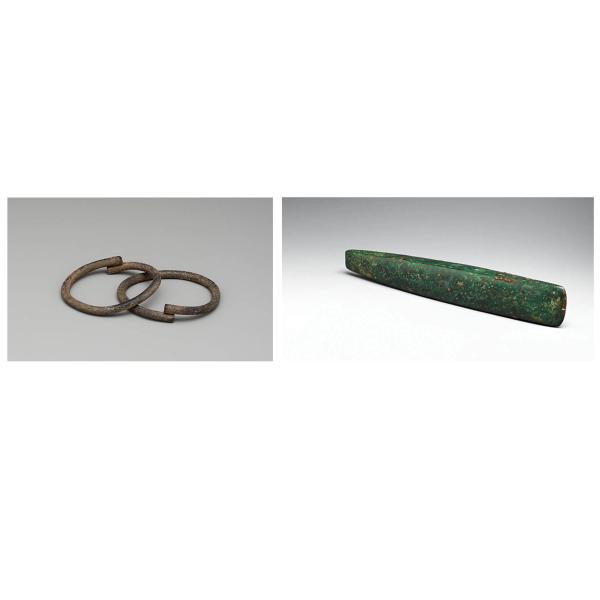
1339. Silver Bracelets & Copper alloy chisel (ca. 2700–2400/2300 BCE)
Narrator: When I look around the gallery, I see a lot of marble and terracotta objects, but fewer in metal. I asked the Archaeologist Sandy MacGillivray, to tell me more about these two particular pieces and the materials that they’re made of.
MacGillivray: This chisel is a very, very unusual and really well-preserved example of the sort of tool that was made from one of the local mineral resources.
Narrator: He explained that the Cycladic islands were rich in copper and the islanders were skilled in how to mine and “smelt” it. On the other hand, other materials, like tin, had to have been imported via trade. What about the silver in the bracelets?
MacGillivray: There are silver mines that were then exploited in the later Greek period and made the Western Cycladic Islands very, very wealthy. But already back in the early Bronze Age, they were extracting the silver. The silver bracelet’s an extremely rare preservation of something that we suspect would have been fairly common. And that is: jewelry crafted from native local silver.
Narrator: And how would the chisel have been used?
MacGillivray: This is the sort of tool that would have been essential for daily life. Tink of boat building, think of building houses, think of building furniture, but also think of roughing out the shapes in marble for the Cycladic figures that we see in these cases.
Narrator: So, the Cycladic islands were incredibly rich in materials that were being traded not just amongst the islanders, but also internationally. Why was there such abundance for them?
MacGillivray: Cycladic Islands are a volcanic ring,it’s called the Hellenic Volcanic Arc. And so it means that there's a lot of activity in the earth. That's why there are so many earthquakes in this region, but that's why it's so rich in mineral resources.
Listen to more about this artwork
Content Notice
The Metropolitan Museum of Art presents over 5,000 years of art from around the world, and our online collection reflects ongoing work conducted over the course of our more than 150-year history. You may encounter objects or images that may be inappropriate for some viewers or information that may be outdated.