Marble female figure
This reclining female figure with flat back slightly protruding buttocks and bent knees is complete, with repairs at the neck and knees. The lyre-shaped head is tilted back with a broad chin, flat crown and long, fine, well-centered nose in relief. Traces of once painted details may suggest a hat (polos) or scarf on the crown and strands of curly hair along the right side and back of the head. A rounded incision delineates the long, upward-tapering neck from a long torso with deeply sloping shoulders. The upper arms curve inward and project slightly at the sides. The forearms are folded left above right beneath widely-spaced, conical breasts and over a slightly rounded belly. Each hand has five fingers indicated by fine grooves. A thin groove separates the belly from lightly curved hips with arched grooves at the tops of the legs to indicate the pubic triangle. The co-joined legs are bent at the knees with incised grooves to indicate knees and ankles. The feet have finely incised grooves to indicate five toes each and are separated from each other at the ankles. The marble is heavily and homogeneously dissolved along calcite grain boundaries, giving the surface a sugary appearance. It is also deeply pitted in some areas. An orange-colored, thin patina containing iron, copper, zinc and lead covers the entire figure, and might be the result of an intense cleaning or surface treatment
This is one of the largest of the more than 50 figures attributed to the Goulandris master named for the N. P. Goulandris Collection in Athens that contains two complete figures, including the largest, by the same hand. All are sturdy female figures carved in the Spedos type and characterized by the classic lyre-shaped head with a shallow chin, narrow arms, small, widely spaced breasts, and a broad abdomen above a small pubic triangle.(1)
Sandy MacGillivray, Dorothy Abramitis, Federico Carò, Elizabeth Hendrix
(1) See Getz-Preziosi, Pat. 1985. Early Cycladic Sculpture: An Introduction. Rev. ed. p. 74, figs. 62 and 63, Malibu: Getty Museum; Getz-Preziosi, Pat. 1987. Early Cycladic Art in North American Collections. cat. no. 78, Goulandris Master, Richmond: Virginia Museum of Fine Arts; Very similar to Thimme, Jürgen, ed. 1977. Art and Culture of the Cyclades: Handbook of an Ancient Civilisation. cat no. 168, Karlsruhe: C. F. Müller.
Artwork Details
- Title: Marble female figure
- Period: Early Cycladic II
- Date: ca. 2500–2400/2300 BCE
- Culture: Cycladic
- Medium: Marble
- Dimensions: Height: 24 7/16 in. (62.2 cm)
Width: 5 5/8 in. (14.3 cm)
Depth: 2 1/2 in. (6.4 cm)
Thickness: 2 1/16 in. (5.2 cm) - Classification: Stone Sculpture
- Credit Line: Leonard N. Stern Collection, Loan from the Hellenic Republic, Ministry of Culture
- Object Number: L.2022.38.58
- Curatorial Department: Greek and Roman Art
Audio
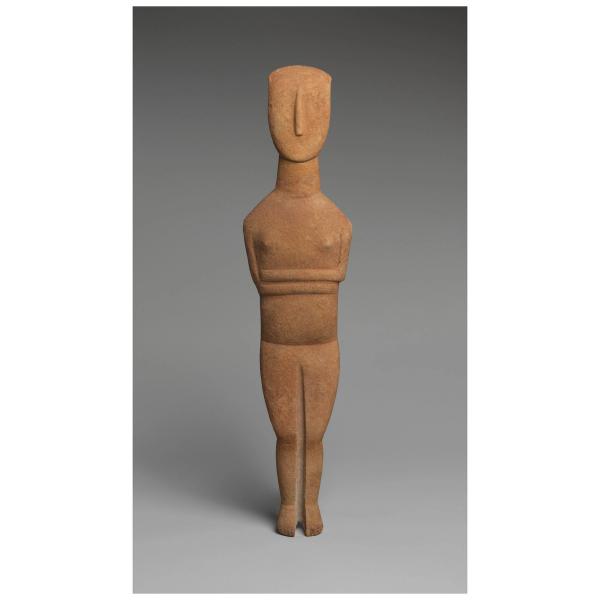
1334. Marble female figure (ca. 2500–2400/2300 BCE)
Narrator: Today, the marble figures surrounding you are a range of faded shades, white and brown. But originally, they were colorful. Archaeologist Sandy MacGillivray has spent years studying these figures, including what would’ve been their appearance when they first left the workshop, thousands of years ago.
MacGillivray: It would’ve had a smooth, brilliant white surface, so this would have been a very, very shiny, beautiful piece that would have then been painted.
Narrator: As we stand here in the museum, can we actually see evidence of this?
MacGillivray: If you look very, very closely at this piece, walking around, see if you can spot the faint traces of what we call a “ghost image” of the eyes. And as you get up to the crown of the head,there's a horizontal line. That suggests there was either a headscarf, some kind of a hat, and then if you look on the sides, you might be able to pick up faint traces of curly hair coming down.
Narrator: I understand that much of Cycladic history is shrouded in mystery, like the identity of the artists.
MacGillivray: So the sculptors who are creating these things, we reckon are going out and finding their own pieces of stone. Think of Michelangelo going to the quarries in Carrara, having to select his own pieces of marble. Nobody else could select those for him. So we think these were highly specialized artists. In other words, we're looking at a very, very complex society that is producing these figures that were once regarded as primitive, but which we can now look at and say, “Well, that's actually quite a spectacular effigy of the female figure.”
Narrator: I was curious if he could walk me through some of the tell-tale features…
MacGillivray: She has the elongated neck, the tilted-back head, the aquiline nose, and the sloping shoulders. Her large belly is very much prominent.
Narrator: I wondered whether we can think of these artist workshops as being anything like an early version of a modern-day studio? Did they have specialized tools, or how did they work?
MacGillivray: One has been excavated recently on the island of Ios and what we find in the workshop are obsidian blades, that is volcanic glass that has been chipped into very, very hard cutting blades. We also find fragments of polishing stones. There's an emery.The emery board that you buy at your pharmacy probably has ground down emery from the island of Naxos on it.
The next step would be to use sand, which you can pick up on the beach and rub if you have a leather mitt on. And then to do any fine polishing, you would use pumice. And that's readily available in the Cycladic Islands because of the volcanic island of Thera.
Content Notice
The Metropolitan Museum of Art presents over 5,000 years of art from around the world, and our online collection reflects ongoing work conducted over the course of our more than 150-year history. You may encounter objects or images that may be inappropriate for some viewers or information that may be outdated.