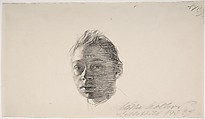
Portrait of Maria Theresia, Queen of Saxony
The drawing, and the related oil and print, were produced in the wake of a turbulent period that witnessed the Napoleonic Wars, the dissolution of the Holy Roman Empire, and, eventually, the establishment of the German Confederation. The Kingdom of Saxony, which had fallen under French control during the wars, emerged much diminished, with sixty percent of its territory ceded to Prussia at the Congress of Vienna. Against the backdrop of continued debate about the political and religious borders of the Saxon state, visual representations of Maria Theresa--daughter of former Holy Roman Emperor Leopold II--may have held special significance.
Artwork Details
- Title: Portrait of Maria Theresia, Queen of Saxony
- Artist: Carl Christian Vogel von Vogelstein (German, 1788–1868)
- Date: 1827
- Medium: Graphite, black chalk, and opaque white watercolor
- Dimensions: Sheet: 11 7/16 × 8 5/16 in. (29 × 21.1 cm)
Mount: 20 13/16 in. × 12 15/16 in. (52.9 × 32.9 cm) - Classification: Drawings
- Credit Line: Gift of Roberta J.M. Olson and Alexander B.V. Johnson, 2023
- Object Number: 2023.599.4
- Curatorial Department: Drawings and Prints
More Artwork


Research Resources
The Met provides unparalleled resources for research and welcomes an international community of students and scholars. The Met's Open Access API is where creators and researchers can connect to the The Met collection. Open Access data and public domain images are available for unrestricted commercial and noncommercial use without permission or fee.
To request images under copyright and other restrictions, please use this Image Request form.
Feedback
We continue to research and examine historical and cultural context for objects in The Met collection. If you have comments or questions about this object record, please contact us using the form below. The Museum looks forward to receiving your comments.
Content Notice
The Metropolitan Museum of Art presents over 5,000 years of art from around the world, and our online collection reflects ongoing work conducted over the course of our more than 150-year history. You may encounter objects or images that may be inappropriate for some viewers or information that may be outdated.