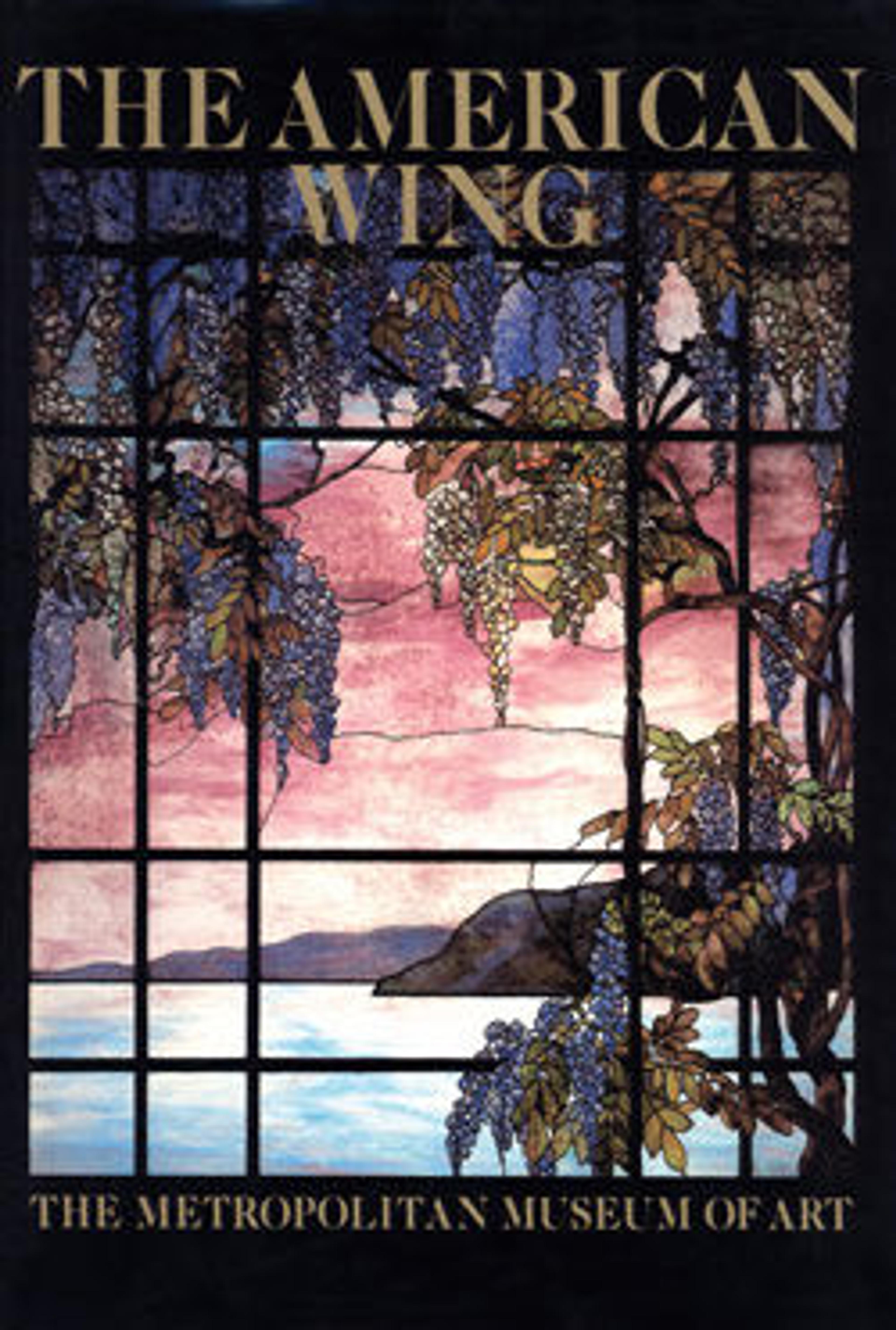
Welcome: Stained Glass Window from the Mrs. George T. Bliss House, New York
Artwork Details
- Title: Welcome: Stained Glass Window from the Mrs. George T. Bliss House, New York
- Maker: John La Farge (American, New York 1835–1910 Providence, Rhode Island)
- Date: 1908–9
- Geography: Made in New York, New York, United States
- Culture: American
- Medium: Leaded opalescent glass, cloisonne glass, copper wire, paint
- Dimensions: 156 x 96 in. (396.2 x 243.8 cm)
- Credit Line: Gift of Susan Dwight Bliss, 1944
- Object Number: 44.90
- Curatorial Department: The American Wing
Audio
3815. Welcome: Stained Glass Window from the Mrs. George T. Bliss House, New York
ALICE COONEY FRELINGHUYSEN: An elegant, life-sized figure of a woman dominates this “Welcome” Window. She wears a shimmering loose-fitting gown reminiscent of Hellenistic Greek drapery. Her expression is blissful. Her right hand is extended in welcome. With her left, she holds open a curtain, which reproduces a Chinese textile decorated with an embroidered pattern of peonies and a golden pheasant. The borders surrounding the central scene are more transparent, to let in more light. The garlands and ornament on an opalescent background recall art from the ancient Roman city of Pompeii.
This masterful window of 1909 is a late work by John La Farge. It looks amazingly like a painting. In 1902, the artist had written: “Window decoration is the art of painting in air with a material carrying colored light.” To achieve the rich colors, harmonious shading, and gradual transition of color you see here, La Farge used the opalescent glass he began to develop in the late 1870s. The new glass was called opalescent because it has the quality of the fire opal. It revolutionized the appearance of stained glass.
Describing the possibilities of opalescent glass in 1902, La Farge noted: “The infinite variety of modulations of tone in the opal glass allowed a degree of light and shade for each piece, which not only gives modeling but also increases depth sufficiently to allow the darker spaces to melt softly into the harsh lead line.”
More Artwork


Related Content
 Free to download
Research Resources
The Met provides unparalleled resources for research and welcomes an international community of students and scholars. The Met's Open Access API is where creators and researchers can connect to the The Met collection. Open Access data and public domain images are available for unrestricted commercial and noncommercial use without permission or fee.
To request images under copyright and other restrictions, please use this Image Request form.
Feedback
We continue to research and examine historical and cultural context for objects in The Met collection. If you have comments or questions about this object record, please contact us using the form below. The Museum looks forward to receiving your comments.
Content Notice
The Metropolitan Museum of Art presents over 5,000 years of art from around the world, and our online collection reflects ongoing work conducted over the course of our more than 150-year history. You may encounter objects or images that may be inappropriate for some viewers or information that may be outdated.