Nydia, the Blind Flower Girl of Pompeii
Artwork Details
- Title: Nydia, the Blind Flower Girl of Pompeii
- Artist: Randolph Rogers (American, Waterloo, New York 1825–1892 Rome)
- Date: 1853–54; carved 1859
- Culture: American
- Medium: Marble
- Dimensions: 54 x 25 1/4 x 37 in. (137.2 x 64.1 x 94 cm)
- Credit Line: Gift of James Douglas, 1899
- Object Number: 99.7.2
- Curatorial Department: The American Wing
Audio
99. Nydia, the Blind Flower Girl of Pompeii, Part 1
Gallery 700
ALICE SCHWARZ: In this sculpture, there's a sense of forward movement, of hurriedness, which actually is most apparent when you look at the piece from the back, and you can appreciate this lunging forward, the pushing off of the left foot at the edge of the base. She moves into the viewer's space. It's almost like you want to step back a little bit to let her keep going!
ERIC KANDEL: Sculptures, because they perform movements, often, reaching out to us, activate parts of the brain that are involved in social interactions, and that's really quite fascinating.
NARRATOR: Our brains respond to the sculpture's position in a specific way. Neuroscientist Eric Kandel explains:
ERIC KANDEL: There's a part of your brain that responds to movement, any kind of movement, a car coming by, a bicycle coming by, but there's another part of the brain that evolves to biological movement. There's a response to the movement of statues, particularly insofar as they move toward us, and we capture that as sort of a tension.
NARRATOR: Nydia also evokes an imagined soundscape.
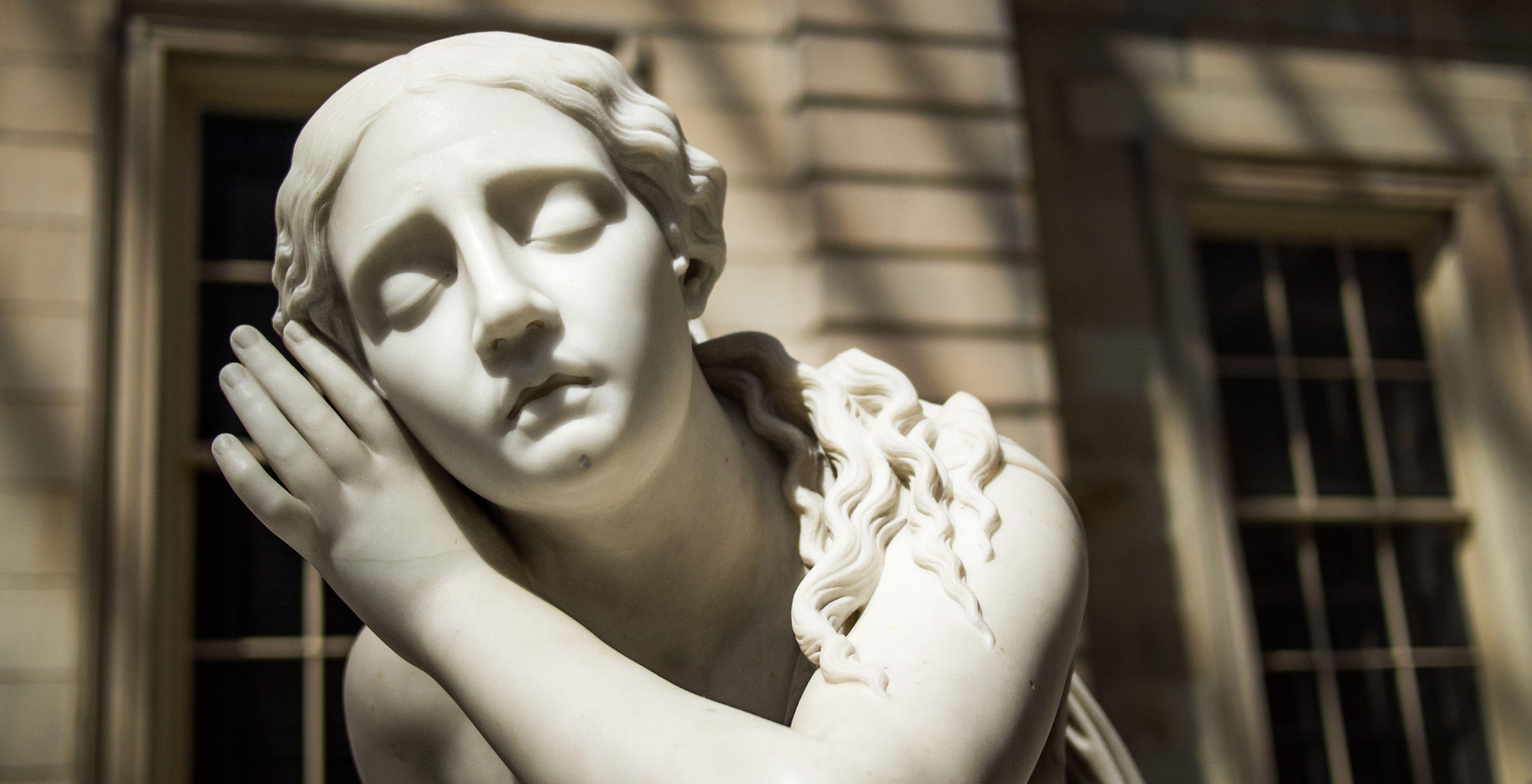
ALICE SCHWARZ: I think the way that her eyes, just gently closed, the long fingers of her left hand that cup her ear, we get a sense immediately, the strength of her sense of hearing. The most important aspect to the story here is something she's listening to.
ERIC KANDEL: The auditory system obviously gets activated, listening to it very carefully. Even though we're looking at something that has no sound whatsoever, the empathy, this poor girl alone, isolated.
Listen to more about this artwork
More Artwork




Related Content

 Free to download
Research Resources
The Met provides unparalleled resources for research and welcomes an international community of students and scholars. The Met's Open Access API is where creators and researchers can connect to the The Met collection. Open Access data and public domain images are available for unrestricted commercial and noncommercial use without permission or fee.
To request images under copyright and other restrictions, please use this Image Request form.
Feedback
We continue to research and examine historical and cultural context for objects in The Met collection. If you have comments or questions about this object record, please contact us using the form below. The Museum looks forward to receiving your comments.
Content Notice
The Metropolitan Museum of Art presents over 5,000 years of art from around the world, and our online collection reflects ongoing work conducted over the course of our more than 150-year history. You may encounter objects or images that may be inappropriate for some viewers or information that may be outdated.