Seated binukedine ( priest)
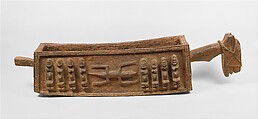
The lower half of the composition is devoted to an expansive treatment of the seat whose two parallel but interconnected discs have been interpreted as metaphors for the parallel spheres of heaven and earth (Ezra 1988:98). According to Hélène Leloup the design of such seats developed in the southern plateau of the Bandiagara Escarpment but their use was extended to its central region (1998:120). The outer band of both seat and base is embellished with a dense abstract pattern evocative of ideas of life-force and power. The zoomorphic imagery that bridges them references the role of the lizard as well as the crocodile, serpent, tortoise and rain bird as intermediaries between divinity and humanity in Dogon cosmology (Van Beek 2001:128).
While the original context for this imposing work is undocumented, such figurative creations by Dogon masters are considered to have been commemorative in nature. Michel Leiris emphasized their role as supports for the nyama, or life force of a deceased individual (1965:178-79). Several interpretations of the identity of the figure have been proposed. According to one of these the depiction may be that of a hogon, a village priest whose high authority was derived from his knowledge of spiritual and temporal affairs (Hoffman in Guggenheim 1996:165). On the basis of his attributes of the iron necklace, diongana, and the iron bell, doro, sounded to incite people to prayer, Hélène Leloup has proposed that the subject is a binu priest, or Binukedine that translates as “the one who is going to return from there,” who served as an intermediary between members of a clan and influential local spirits (Leloup 1998:120; DeMott:54). The binu cult was devoted to maintaining a balance between the supernatural world and human community. Its priest was responsible for mediating between these realms and invoking the supernatural world to contribute to the well-being and fertility of the clan. His communion with powerful binu spirits induced a trance state that may be reflected in the figure’s facial expression (Van Beek 2001:39).
Alisa LaGamma
Sources cited:
Art of the Dogon. Exhibition catalogue by Kate Ezra, published by the The Metropolitan Museum of Art. New York, 1988.
DeMott, Barbara. Dogon Masks: A Structural Study in Form and Meaning. Ann Arbor: UMI Press, 1979.
Hoffman, Rachel. In Africa: The Art of a Continent. Exhibition catalogue published by The Solomon R. Guggenheim Museum, New York, 1996, p.165.
Leiris, M. “Réflexions sur la statuaire religieuse de l’Afrique Noire,” Les Religions Africaines Traditionnelles. Paris, 1965, pp. 171-97.
Leloup, Hélène. Dogon-Meisterwerke Der Skulptur/Chefs-d’Oeuvre de la Statuaire Dogon. Exhibition catalogue published by Galerie der Stadt, Stuttgart, 1998.
Van Beek, Walter. Dogon: Africa’s People of the Cliffs. New York: Harry N. Abrams, Inc., 2001.
Published:
Leloup, Hélène. Dogon. Exhibition catalogue, Musée du Quai Branly, Paris, 2011, Cat. No. 42, pp. 268-69.
Musée Dapper. Dogon. Exhibition catalogue, Paris, 1994, p.53.
Artwork Details
- Title: Seated binukedine ( priest)
- Artist: Dogon blacksmith
- Date: 18th–19th century
- Geography: Mali
- Culture: Dogon peoples
- Medium: Wood, iron
- Dimensions: H. 28 11/16 x W. 11 1/2 x D. 12 1/2 in. (72.9 x 29.2 x 31.8 cm)
- Classification: Wood-Sculpture
- Credit Line: The Michael C. Rockefeller Memorial Collection, Gift of Nelson A. Rockefeller, 1965
- Object Number: 1978.412.455
- Curatorial Department: The Michael C. Rockefeller Wing
More Artwork
Related Content
Research Resources
The Met provides unparalleled resources for research and welcomes an international community of students and scholars. The Met's Open Access API is where creators and researchers can connect to the The Met collection. Open Access data and public domain images are available for unrestricted commercial and noncommercial use without permission or fee.
To request images under copyright and other restrictions, please use this Image Request form.
Feedback
We continue to research and examine historical and cultural context for objects in The Met collection. If you have comments or questions about this object record, please contact us using the form below. The Museum looks forward to receiving your comments.
Content Notice
The Metropolitan Museum of Art presents over 5,000 years of art from around the world, and our online collection reflects ongoing work conducted over the course of our more than 150-year history. You may encounter objects or images that may be inappropriate for some viewers or information that may be outdated.