Chessmen (32)
The use of boats instead of chariots is a somewhat late innovation in Indian chess, found in a few other Oriental countries, Siam and Annam, for example. The only European country in which it occurs is Russia, a phenomenon for which no very convincing explanation has yet been produced. Trade connections with India were, however, established in the reign of Ivan the Terrible (1544–1584) and continued later, although no territorial claims were established, and perhaps this has some bearing on the problem. The replacement of the original elephant (bishop) by a camel is common in Indian figural sets. It also appears in the nomenclature of the nonfigural pieces in the greater part of central Asia and the Deccan, and in Mongol chess. In Indian chess where the boat is not used as the rook, the elephant functions in its stead.
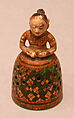
Sets such as this, representing an opposition of British and Indians, and elegantly carved, were probably made especially for British clients. The set is reputed to have belonged to the famous first governor of India, Warren Hastings (1732–1818), whose career was centered in Bengal, but no proof for this suggestion exisits. The period, however, would seem correct.
Artwork Details
- Title: Chessmen (32)
- Date: late 18th–early 19th century
- Culture: Indian
- Medium: Ivory with polychrome lacquer and gilding
- Dimensions: Height (King): 3 in. (7.6 cm);
Height (each pawn): 1 1/2 in. (3.8 cm) - Classification: Chess Sets
- Credit Line: Gift of Gustavus A. Pfeiffer, 1948
- Object Number: 48.174.151a–p, aa–pp
- Curatorial Department: European Sculpture and Decorative Arts
More Artwork
Related Content
 Free to download
Research Resources
The Met provides unparalleled resources for research and welcomes an international community of students and scholars. The Met's Open Access API is where creators and researchers can connect to the The Met collection. Open Access data and public domain images are available for unrestricted commercial and noncommercial use without permission or fee.
To request images under copyright and other restrictions, please use this Image Request form.
Feedback
We continue to research and examine historical and cultural context for objects in The Met collection. If you have comments or questions about this object record, please contact us using the form below. The Museum looks forward to receiving your comments.
Content Notice
The Metropolitan Museum of Art presents over 5,000 years of art from around the world, and our online collection reflects ongoing work conducted over the course of our more than 150-year history. You may encounter objects or images that may be inappropriate for some viewers or information that may be outdated.