Der Farnesische Tisch
Artwork Details
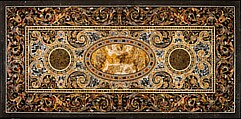
- Titel: Der Farnesische Tisch
- Datum: ca. 1569
- Medium: Marmor, Ägyptischer Alabaster, Halbedelsteine
- Dimensionen: 95 x 379 x 168 cm
- Anerkennung: Harris Brisbane Dick Fund, 1957
- Akzession Nr.: 58.57a–d
- Curatorial Department: European Sculpture and Decorative Arts
Audio
2178. The Farnese Table
IAN WARDROPPER: I’m Ian Wardropper, Chairman of the Department of European Sculpture and Decorative Arts. If you're a frequent visitor to The Met, you may have passed this table without realizing its significance. Look first at the materials. Curator Wolfram Koeppe.
WOLFRAM KOEPPE: You see on the top of the table two enormous Egyptian alabaster slabs, which most likely were excavated or taken from an ancient Roman building, but even the Romans were known for taking those things as spoils from Egypt, so they may have been reused two, three, or four times until they ended up in this beautiful tabletop.
IAN WARDROPPER: The table is a distillation of the ancient world, both in its materials and in its design. The marbles come from Roman sources, and so do the motifs, for instance, the abstracted shield shapes, or peltae, in the border. Renaissance artists saw themselves as rivaling with the ancients and striving to surpass them. So this table represents both an homage to antiquity and a triumph over it.
The table top is a brilliant example of pietre dure, that is, work in colored hardstones, often assembled into a mosaic like this one. Pietre dure of this kind was especially prized in the late Renaissance, when this table was made for Cardinal Alessandro Farnese. It stood in the center of a grand room in his palace, among outstanding works of classical statuary and paintings of his own day. Imagine the moment when the table first arrived there: it weighs some thirty thousand pounds, and even today, it takes twelve men and several days to move it. In the Palazzo Farnese, the table was treated as the treasure that it is—an inventory tells us that whenever the Cardinal was away, it was covered with leather and encased in a wooden box with a padlock and chain.
More Artwork
![The Finding of Moses, Jacopo [Giacomo] Barozzi da Vignola Italian, Wood, Italian](https://images.metmuseum.org/CRDImages/es/web-additional/ES7918.jpg)
Related Content

Research Resources
The Met provides unparalleled resources for research and welcomes an international community of students and scholars. The Met's Open Access API is where creators and researchers can connect to the The Met collection. Open Access data and public domain images are available for unrestricted commercial and noncommercial use without permission or fee.
To request images under copyright and other restrictions, please use this Image Request form.
Feedback
We continue to research and examine historical and cultural context for objects in The Met collection. If you have comments or questions about this object record, please contact us using the form below. The Museum looks forward to receiving your comments.
Content Notice
The Metropolitan Museum of Art presents over 5,000 years of art from around the world, and our online collection reflects ongoing work conducted over the course of our more than 150-year history. You may encounter objects or images that may be inappropriate for some viewers or information that may be outdated.