Nine-light candelabrum
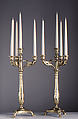
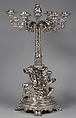
The candelabrum is an example of a second phase of the Rococo—that style of the eighteenth century which reached its greatest development in the use of asymmetry almost a century before this piece was made. Here the difference is in the symmetrical combination of asymmetrical, smaller units, such as scrolls and large leaf forms, as well as the two little cupids who seem to be pursuing on a spiral path one little Psyche, who ascends the central shaft holding a rose. Added to the grand scale and presence of many diverse elements are the brilliantly burnished gilt surfaces alternating with other areas that are matte or broken up with ornament such as trellis panels.
Artwork Details
- Title: Nine-light candelabrum
- Maker: Paul Storr (British, 1771–1844)
- Date: 1835–36
- Culture: British, London
- Medium: Silver, gilt
- Dimensions: Overall (confirmed): 40 1/2 × 27 1/2 × 27 1/2 in. (102.9 × 69.9 × 69.9 cm)
- Classification: Metalwork-Silver
- Credit Line: Bequest of Rupert L. Joseph, 1959
- Object Number: 60.55.10a–s
- Curatorial Department: European Sculpture and Decorative Arts
More Artwork

Related Content

 Free to download
Research Resources
The Met provides unparalleled resources for research and welcomes an international community of students and scholars. The Met's Open Access API is where creators and researchers can connect to the The Met collection. Open Access data and public domain images are available for unrestricted commercial and noncommercial use without permission or fee.
To request images under copyright and other restrictions, please use this Image Request form.
Feedback
We continue to research and examine historical and cultural context for objects in The Met collection. If you have comments or questions about this object record, please contact us using the form below. The Museum looks forward to receiving your comments.
Content Notice
The Metropolitan Museum of Art presents over 5,000 years of art from around the world, and our online collection reflects ongoing work conducted over the course of our more than 150-year history. You may encounter objects or images that may be inappropriate for some viewers or information that may be outdated.