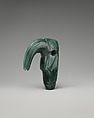
Labret with eagle head
Eagles were symbolically embedded within Mexica thought. In their mythological origins, the Mexica were divinely instructed by Huitzilopochtli, patron god of the Mexica, to settle on an island where an eagle was perched above a prickly pear cactus—becoming the nexus of the Mexica world, Tenochtitlan. The Codex Mendoza, a colonial document, depicts the mythical founding of Tenochtitlan by centering a Golden Eagle (Aquila crhysaetos) atop a prickly pear cactus on its frontispiece. As entities of the realm above land, the eagle’s ability to soar across the sky resembled the Sun’s passage traversing through the heavens above and underworld below. Such a journey was fit for only the most precious of beings, much like the dauntless eagle.
As a sacred bird of prey fashioned from an equally sacred material, this rather ornate labret would immediately distinguish the status of its wearer. Gold, or teocuitlatl in Nahuatl, was believed to be the earthly materialization of the gods’ excrement. Its radiant and glowing qualities were intimately tied to the gods and were exclusively worn by the Mexica ruler—the huey tlatoani (great speaker)—and his military allies. A folio in the Codex Ixtlilxochitl presents the Texcoco tlatoani Nezahualcoyotl dressed in sacred warrior regalia, wearing an eagle-headed labret much like the present example. Embodying the unmatched ferocity of an eagle, this and other labrets featuring eagle heads would have likely been worn as military regalia exclusive to elite warriors.
Carol Velandia, Adrienne Arsht Intern, 2024
Further Reading
Alva Ixtlilxochitl, Fernando de. 1582. Codex Ixlilxochitl, Folios 105v and 106r. https://www.loc.gov/item/2021668123/.
Evans, Susan Toby, ed. Ancient Mexican Art at Dumbarton Oaks: Central Highlands, Southwestern Highlands, Gulf Lowlands. Washington, DC: Dumbarton Oaks Research Library and Collection, 2010, p. 108-109, no. 36.
McEwan, Colin., López Luján, Leonardo, and Consejo Nacional para la Cultura y las Artes. Moctezuma: Aztec Ruler. London: British Museum, 2009, p. 86-88.
Codex Mendoza, the Mexican Manuscript Known as the Collection of Mendoza and Preserved in the Bodleian Library, Oxford. 1938. Waterlow & Sons, Limited. https://collections.library.yale.edu/catalog/17373370.
Pillsbury, Joanne, Timothy F. Potts, and Kim N. Richter, eds. Golden Kingdoms: Luxury Arts in the Ancient Americas. Los Angeles: J. Paul Getty Museum, 2017, p. 256, no. 204.
Sahagun, Bernardino de. Florentine Codex: General History of the Things of New Spain. Book 11, Earthly Things. Translated by Arthur J.O. Anderson and Charles E. Dibble. Santa Fe, N.M.: School of American Research; Salt Lake City: University of Utah Press, 1953-1982.
Artwork Details
- Title: Labret with eagle head
- Artist: Mexica artist(s)
- Date: 1325–1521 CE
- Geography: Mexico, Mesoamerica
- Culture: Mexica (Aztec)
- Medium: Gold
- Dimensions: H. 5/8 × W. 1 1/4 × D. 1 1/2 in. (1.6 × 3.2 × 3.8 cm)
- Classification: Metal-Ornaments
- Credit Line: The Michael C. Rockefeller Memorial Collection, Purchase, Nelson A. Rockefeller Gift, 1967
- Object Number: 1978.412.218
- Curatorial Department: The Michael C. Rockefeller Wing
More Artwork
Research Resources
The Met provides unparalleled resources for research and welcomes an international community of students and scholars. The Met's Open Access API is where creators and researchers can connect to the The Met collection. Open Access data and public domain images are available for unrestricted commercial and noncommercial use without permission or fee.
To request images under copyright and other restrictions, please use this Image Request form.
Feedback
We continue to research and examine historical and cultural context for objects in The Met collection. If you have comments or questions about this object record, please contact us using the form below. The Museum looks forward to receiving your comments.
Content Notice
The Metropolitan Museum of Art presents over 5,000 years of art from around the world, and our online collection reflects ongoing work conducted over the course of our more than 150-year history. You may encounter objects or images that may be inappropriate for some viewers or information that may be outdated.