Bis-Stab
Artwork Details
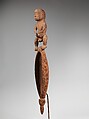
- Titel: Bis-Stab
- Datum: Späte 1950er Jahre
- Geografie: Neuguinea, Indonesien, Provinz Papua (Irian Jaya), Dorf Omadesep
- Kultur: Asmat-Volk
- Medium: Holz, Farbe, Pflanzenfasern
- Dimensionen: H: 5,5 m
- Anerkennung: The Michael C. Rockefeller Memorial Collection, aus dem Nachlass von Nelson A. Rockefeller, 1979
- Akzession Nr.: 1979.206.1611
- Curatorial Department: The Michael C. Rockefeller Wing
Audio
113. Bis Poles
Not on view
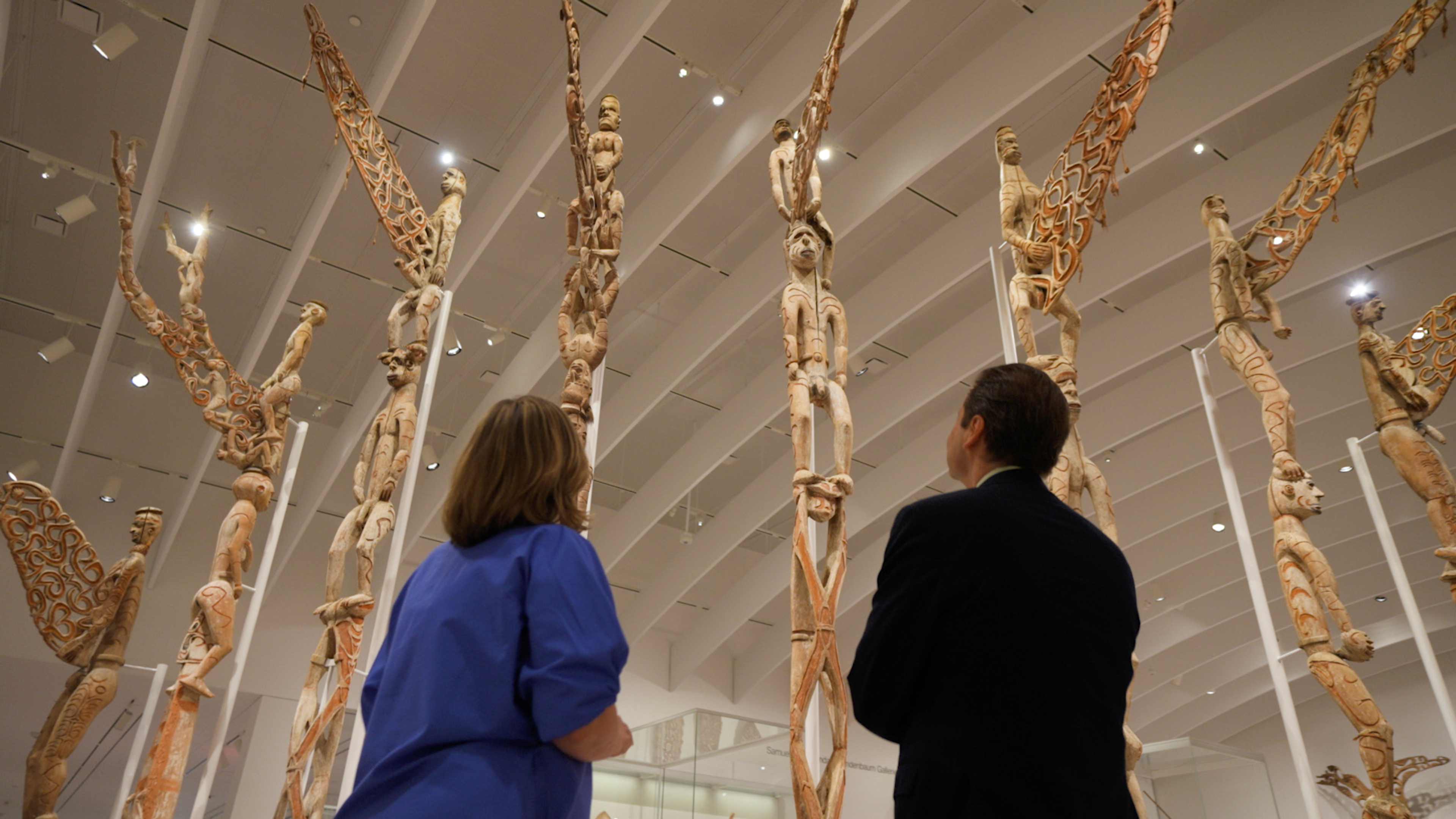
The Pacific Islands are home to many cultures, each with a distinct artistic tradition. Some are noted for producing small objects, but this gallery contains the most monumental works. Let’s focus on the particularly impressive tall posts, called bis poles, displayed here in a row by the windows. Much art from the cultures of this region—known collectively as Oceania—is produced in the context of religious ritual. And the bis poles—or ancestor poles—offer an evocative example.
When a death occurs among the Asmat people of southwestern New Guinea, it is thought to create a dangerous imbalance that must be remedied by the living. The creation of a bis pole is part of a ritual intended to restore order within the community. In secrecy, a group of men carves the pole from a single tree, inverting it so that one of the roots becomes the projection at the top. Each figure on the pole represents a specific person who has died. Once the pole is complete, the men set it up outside their ceremonial house. The community holds a ceremonial feast to honor the deceased and send their spirits on to the world of the ancestors. At the end of the ceremony, the bis pole is returned to a grove of sago palms, an essential food source. There, the pole decays and its supernatural power is believed to seep into the ground, strengthening the palms and ensuring an abundant harvest of sago. The threatening forces of death have been converted to nourish the living.
Let’s turn now to another part of the world, to see a different way of honoring an individual in ceremonial rituals.
More Artwork
Related Content

Research Resources
The Met provides unparalleled resources for research and welcomes an international community of students and scholars. The Met's Open Access API is where creators and researchers can connect to the The Met collection. Open Access data and public domain images are available for unrestricted commercial and noncommercial use without permission or fee.
To request images under copyright and other restrictions, please use this Image Request form.
Feedback
We continue to research and examine historical and cultural context for objects in The Met collection. If you have comments or questions about this object record, please contact us using the form below. The Museum looks forward to receiving your comments.
Content Notice
The Metropolitan Museum of Art presents over 5,000 years of art from around the world, and our online collection reflects ongoing work conducted over the course of our more than 150-year history. You may encounter objects or images that may be inappropriate for some viewers or information that may be outdated.