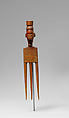
Khaandu (ceremonial axe)
The carved head, with protruding ears and wide-open eyes, represents the head of a matrilineage, while the full figure sitting on its crown likely depicts a descendent in the matrilineal line. The Yaka trace their descent through their maternal ancestors and honor the relatives in their mother's line going back for at least three generations. Matrilineages control rights to land, used for agriculture and hunting, and protect and empower their members with the blessings of the ancestors. When displeased, they are also believed to inflict harm and misfortune. These associations underscore the khaandu's role as a symbol of lineage membership. The leemba would have carried it over his left shoulder when visiting his relatives. When carried in this position the full figure lying behind the head would have been upright and faced anyone looking at the bearer.
Enid Schildkrout, 2025
Curator Emerita, American Museum of Natural History
Artwork Details
- Title: Khaandu (ceremonial axe)
- Artist: Yaka artist
- Date: Late 19th–first half of 20th century
- Geography: Democratic Republic of the Congo
- Culture: Yaka peoples
- Medium: Iron, wood
- Dimensions: H. 10 1/4 in. × W. 2 in. × D. 10 1/2 in. (26 × 5.1 × 26.7 cm)
- Classification: Metal-Implements
- Credit Line: Gift of Mr. and Mrs. R. H. Smith, 1981
- Object Number: 1981.421
- Curatorial Department: The Michael C. Rockefeller Wing
More Artwork
Research Resources
The Met provides unparalleled resources for research and welcomes an international community of students and scholars. The Met's Open Access API is where creators and researchers can connect to the The Met collection. Open Access data and public domain images are available for unrestricted commercial and noncommercial use without permission or fee.
To request images under copyright and other restrictions, please use this Image Request form.
Feedback
We continue to research and examine historical and cultural context for objects in The Met collection. If you have comments or questions about this object record, please contact us using the form below. The Museum looks forward to receiving your comments.
Content Notice
The Metropolitan Museum of Art presents over 5,000 years of art from around the world, and our online collection reflects ongoing work conducted over the course of our more than 150-year history. You may encounter objects or images that may be inappropriate for some viewers or information that may be outdated.