Staff with Saint Anthony of Padua
Like the Kongo crucifix, the figure of St. Anthony became associated with secular prestige in the nineteenth century. Investiture ceremonies emphasized the connection between royal power and iron well into the nineteenth century, when mvwala staffs came into favor among regional chiefs. The wood or ivory figurative finials of mvwala staffs incorporate iconography and poses that reference the lineage of the owner. In this unusual example, the staff features a Saint Anthony pendant as its finial, announcing its Christian authority along with its ancient invocation of Kongo power. The staff’s slender iron tip allows it to be planted into the earth, linking the owner to the realm of the ancestors. Two flattened orbs with incised longitudinal lines punctuate the length of the smooth, red-brown wooden shaft. These orbs are makolo, symbolic of key points within a leader’s reign. The incised lozenges—arranged as pairs, trios, and chain-like strands along the staff at the base of the figure’s feet—are not decorative, but allude to a network of ancestors who grant chiefly power. Examinations performed in 2001, 2002, and 2013 by Conservator Ellen Howe, Conservator Leslie Gat, Conservation Scientist Mark Wypyski, Conservation Scientist Adriana Rizzo, and Conservation Fellow Ainslie Harrison, suggest that the brass pendant finial was most likely cast around a core, and then later attached to a metal hilt, indicating both its method of creation and its multiple uses over time.
Catholic since the late fifteenth century, the Kongo Kingdom fostered devotion to many saints. St. Anthony was among the foremost, and was called Toni Malau ("Anthony of Good Fortune") for his purported powers of healing and good luck. The popularity of Saint Anthony in Kongo was part of an early modern phenomenon in which the saint was equally popular in Europe, South America, and Africa. Born in Lisbon, Portugal in 1195, the Franciscan brother Anthony was canonized just one year after his 1231 death in Padua, Italy. Claimed as a patron saint by both Portugal and Italy, religious missionaries from both regions spread his cult globally. Soon after their 1645 arrival in Kongo, Italian Capuchin fathers began to spread the cult of St. Anthony. While most early images of the saint were brought from Europe, some came to Africa via other sources. Most missionaries traveled indirectly to Africa via Brazil, where they sometimes purchased religious sculptures from Portuguese colonial workshops. In the Kongo kingdom, locally made figures of Saint Anthony based on European prototypes became common around the eighteenth century. The practice most likely related to the saint’s popularity in the kingdom, and was possibly tied to the short-lived Antonian movement, during which the Kongo noble woman Beatriz Kimpa Vita gained a significant political following after declaring herself the reincarnation of St. Anthony. While the Antonien movement was successfully put down in 1706, St. Anthony remained popular long after. Considered the "Saint of Good Fortune" or the "Saint of Prosperity," Toni Malau figures continued to be used prominently in Kongo as forms of protection from illness, the troubles of childbirth, or other problems. They also were adapted into symbols of Christian power, as in this staff.
Kristen Windmuller-Luna, 2016
Sylvan C. Coleman and Pam Coleman Memorial Fund Fellow in the Department of the Arts of Africa, Oceania, and the Americas
Exhibition history
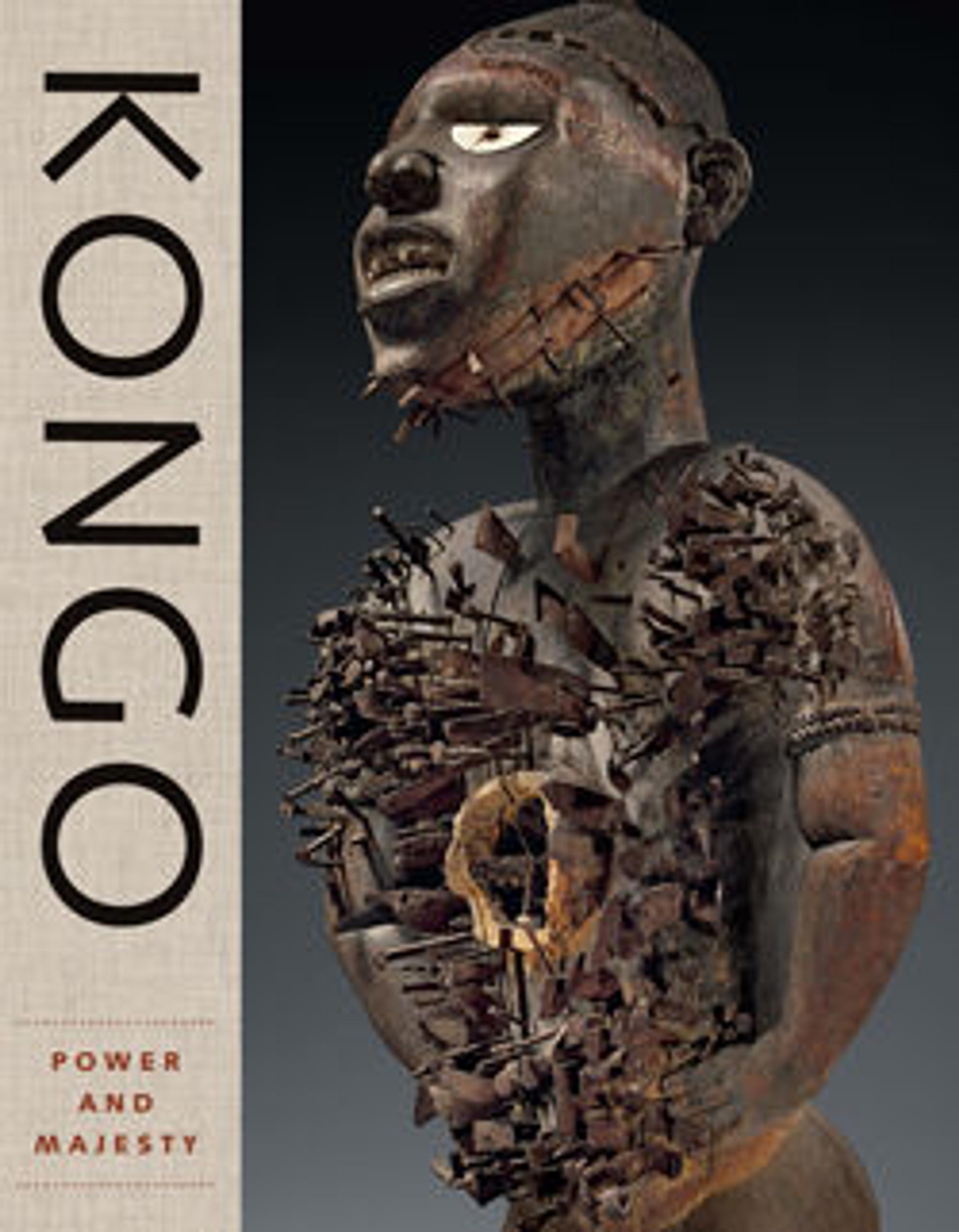
"Kongo: Power and Majesty," The Metropolitan Museum of Art, New York, NY: September 18, 2015–January 3, 2016
"African, Oceanic, and Ancient American Art: Recent Acquisitions," Michael C. Rockefeller Special Exhibition Gallery, The Metropolitan Museum of Art, New York, NY: May 22–Oct. 28, 2001
References
LaGamma, Alisa.Kongo: Power and Majesty. New York: The Metropolitan Museum of Art, 2015, pp. 116–17, fig. 72.
LaGamma, A. 2001. "New Acquisitions: The Metropolitan Museum of Art, New York." African Arts. XXXIV (2):72–77.
Further reading
Fromont, Cécile. The Art of Conversion: Christian Visual Culture in the Kingdom of Kongo. Chapel Hill, NC: University of North Carolina Press, 2014.
Pereira, Mario, and Kristen Windmuller-Luna. Kongo Christian Art: Cross-Cultural Interaction in the Atlantic World."
Kongo: Power and Majesty Exhibition Blog, The Metropolitan Museum of Art (blog), October 30, 2015.
Thornton, John K. The Kongolese Saint Anthony: Dona Beatriz Kimpa Vita and the Antonian Movement, 1684–1706. Cambridge, U.K.: Cambridge University Press, 1998.
Artwork Details
- Title: Staff with Saint Anthony of Padua
- Artist: Kongo artist
- Date: 19th century
- Geography: Democratic Republic of the Congo; Republic of the Congo; Angola
- Culture: Kongo peoples
- Medium: Brass, wood, iron
- Dimensions: H. 41 1/2 × W. 2 × D. 2 3/8 in. (105.4 × 5.1 × 6 cm)
- Classification: Metal-Sculpture
- Credit Line: Gift of Ernst Anspach, 1999
- Object Number: 1999.295.2
- Curatorial Department: The Michael C. Rockefeller Wing
More Artwork
Related Content

Research Resources
The Met provides unparalleled resources for research and welcomes an international community of students and scholars. The Met's Open Access API is where creators and researchers can connect to the The Met collection. Open Access data and public domain images are available for unrestricted commercial and noncommercial use without permission or fee.
To request images under copyright and other restrictions, please use this Image Request form.
Feedback
We continue to research and examine historical and cultural context for objects in The Met collection. If you have comments or questions about this object record, please contact us using the form below. The Museum looks forward to receiving your comments.
Content Notice
The Metropolitan Museum of Art presents over 5,000 years of art from around the world, and our online collection reflects ongoing work conducted over the course of our more than 150-year history. You may encounter objects or images that may be inappropriate for some viewers or information that may be outdated.