A Brazilian Landscape
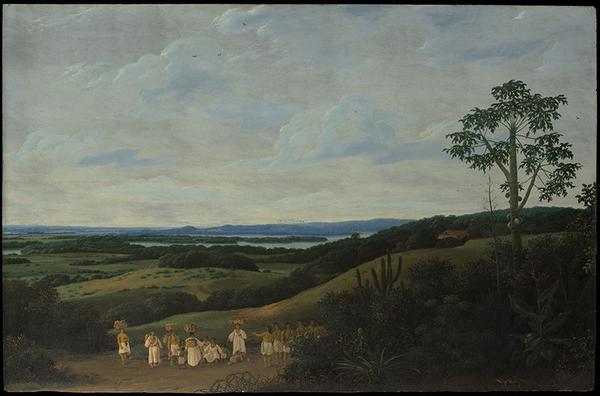
From 1630 to 1654, the Dutch colony in northern Brazil, appropriated from the Portuguese, forcibly dispossessed Indigenous populations of their land. Post and a naturalist accompanied the governor to the area and recorded flora and fauna (such as the foreground iguana). The landscapes he produced after returning home mix observation with fantasy. Post’s painting hides the process by which natural resources were obtained. Absent are obvious references to the enslavement of African people and their forced labor on plantations, the basis of Dutch colonial wealth. Indigenous families appear at rest, apparently after hunting and food gathering. Routinely treated as generic figures in Dutch representations, Indigenous Brazilian groups include the Aymoré, Potiguara, Tarairiu, and Tupinambá, among others.
Artwork Details
- Title: A Brazilian Landscape
- Artist: Frans Post (Dutch, Haarlem 1612–1680 Haarlem)
- Date: 1650
- Medium: Oil on wood
- Dimensions: 24 x 36 in. (61 x 91.4 cm)
- Classification: Paintings
- Credit Line: Purchase, Rogers Fund, special funds, James S. Deely Gift, and Gift of Edna H. Sachs and other gifts and bequests, by exchange, 1981
- Object Number: 1981.318
- Curatorial Department: European Paintings
Audio
5246. Frans Post, Brazilian Landscape
ADAM EAKER: There really was a hunger, on the part of the Dutch art-buying public, for scenery that they couldn’t see out their front door.
NARRATOR: The artist Frans Post met the public’s appetite with paintings like this one. In this case, the governor of Dutch Brazil, then known as New Holland, invited Post and other artists to visit the colony to create works that would promote its riches back home.
ADAM EAKER: Even though he has individual motifs that might have been very exotic or unfamiliar, he makes sure that this is an image that is still legible to a Dutch eye. Post was imposing European landscape conventions onto this Brazilian landscape, so you have the use of atmospheric perspective to achieve the effect of recession. You have plants, even an exotic cactus used to achieve this setting off the foreground from the background.
NARRATOR: Post based this sweeping view on sketches he made of Brazil's diverse flora and fauna, such as the iguana in the bottom right. But he didn't actually paint this work until six years after his return home. Working from sketches and recollections, he grouped indigenous men, women, and children in the lower center.
ADAM EAKER: These really are the fantasies of colonial power. They do include elements of actual observation, but they’re really confections that offer a kind of perspective of ownership or conquest that doesn’t really reflect reality.
NARRATOR: Dutch rule in northern Brazil was short-lived. The Dutch eventually surrendered the colony to the Portuguese. Yet Post continued to paint landscapes such as this, perhaps out of nostalgia for what was lost.
ADAM EAKER: If the Dutch couldn’t own a piece of Brazil, they could own landscapes.
More Artwork

Related Content
 Free to download
Research Resources
The Met provides unparalleled resources for research and welcomes an international community of students and scholars. The Met's Open Access API is where creators and researchers can connect to the The Met collection. Open Access data and public domain images are available for unrestricted commercial and noncommercial use without permission or fee.
To request images under copyright and other restrictions, please use this Image Request form.
Feedback
We continue to research and examine historical and cultural context for objects in The Met collection. If you have comments or questions about this object record, please contact us using the form below. The Museum looks forward to receiving your comments.
Content Notice
The Metropolitan Museum of Art presents over 5,000 years of art from around the world, and our online collection reflects ongoing work conducted over the course of our more than 150-year history. You may encounter objects or images that may be inappropriate for some viewers or information that may be outdated.