Noli Me Tangere
The panels were likely created by a travelling workshop based in the nearby town of Judenburg. The various hands and styles of the different craftspeople can be discerned in the subtle variations on common themes. The Judenburg workshop relied on a limited set of cartoons, or full-scale reusable drawings that outlined poses, facial features, and shading, to create their standard repertoire of figures. This is why so many of the saints appear visually similar; they were made using a shared set of designs.
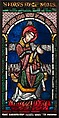
Mary Magdalene was the first of Christ’s followers to encounter him outside his empty tomb. He is shown carrying a gardening tool, emphasizing that she initially mistook him for a groundskeeper. Upon recognizing him as the risen Christ, Mary Magdalene reached out but he promptly responded "Touch me not!" (Noli me tangere in Latin) and twisted his body away. The drama of this scene encouraged medieval viewers to imagine this painfully fragile moment after Christ was crucified but before he had ascended into Heaven.
.
Artwork Details
- Title: Noli Me Tangere
- Date: 1340–50
- Geography: Made in Carinthia, Austria
- Culture: Austrian
- Medium: Pot-metal and colorless glass with vitreous paint
- Dimensions: 36 x 13 3/4 in. (91.4 x 34.9 cm)
with modern border: 36 1/4 × 19 × 5/8 in. (92.1 × 48.3 × 1.6 cm) - Classification: Glass-Stained
- Credit Line: The Cloisters Collection, 1968
- Object Number: 68.224.2
- Curatorial Department: Medieval Art and The Cloisters
More Artwork



Related Content
 Free to download
Research Resources
The Met provides unparalleled resources for research and welcomes an international community of students and scholars. The Met's Open Access API is where creators and researchers can connect to the The Met collection. Open Access data and public domain images are available for unrestricted commercial and noncommercial use without permission or fee.
To request images under copyright and other restrictions, please use this Image Request form.
Feedback
We continue to research and examine historical and cultural context for objects in The Met collection. If you have comments or questions about this object record, please contact us using the form below. The Museum looks forward to receiving your comments.
Content Notice
The Metropolitan Museum of Art presents over 5,000 years of art from around the world, and our online collection reflects ongoing work conducted over the course of our more than 150-year history. You may encounter objects or images that may be inappropriate for some viewers or information that may be outdated.