From the Faraway, Nearby
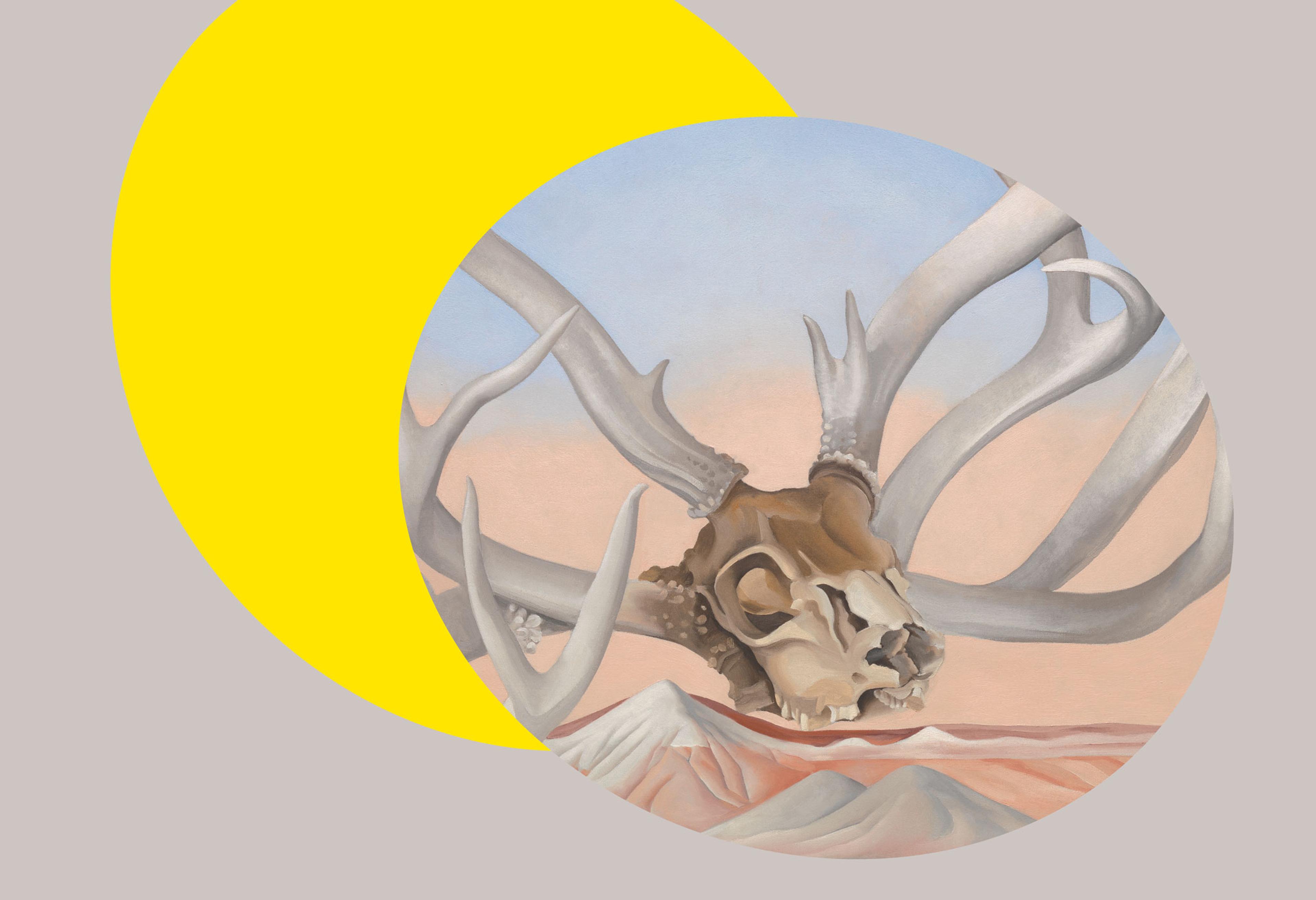
From the Faraway, Nearby and related pictures attest to O’Keeffe’s artistic engagement with bones, usually extended well beyond conventional still life painting. These imaginative, quasi-surreal compositions often incorporate abstract and landscape elements, underscoring the innate energy she believed the bones possessed, in addition to their eternal spiritual ties to their native arid environs. From the Faraway, Nearby features a mule deer skull and antlers levitating over a rather generalized desert landscape. Closer inspection reveals two sets of antlers, which, combined, result in a profusion of writhing horns that nearly fills the composition and recalls the head of Medusa. O’Keeffe omitted any suggestion of a conventional middle ground, choosing, rather, to emphasize a gulf of imagined space between the distant landscape and the deer bones that confront the viewer, a dynamic relationship and difference that resonates with the words "faraway" and "nearby" in the painting’s title.
Intriguingly, O’Keeffe exhibited From the Faraway, Nearby early on as Deer's Horns, Near Cameron, a designation that remained attached to the work until at least 1966. The former title places the scene in Arizona—not New Mexico—specifically near Cameron, a small town on Diné Bikéyah (homelands of the Navajo Nation) close to the Grand Canyon’s southern rim. O’Keeffe visited the region in 1937 during a camping expedition with a friend, photographer Ansel Adams. Consequently, the painter may have intended the landscape element to reference the so-called "Painted Desert," a geological attraction near the town. Likewise, the imposing skull with antlers functions in some capacity as an emblem of the robust mule deer population that still roams this part of Arizona.
While O’Keeffe’s rationale for changing the painting’s title is unknown, her move away from the literal description toward one more poetic emphasizes the composition’s evocative overall effect. Moreover, her inclusion of the words "faraway" and "nearby" provides a discreet personal and private inflection alluding to her relationship with Alfred Stieglitz, who, in correspondence while they were apart, referred to O’Keeffe occasionally as "my Far Away One," "My Great-White-Faraway-So-Near-One," and other variations of this idea.
The deer skull may also surreptitiously signal O’Keeffe’s subject position as a white woman in relation to surrounding Indigenous communities and cultures. Removed by O’Keeffe from its natural environs and "installed" by the artist in a landscape setting of her own imagination, the horned skull begins to register as a prized big game trophy, but from a different kind of hunt, a subject that printmakers, photographers, and painters have commemorated in their work across time and place. In a striking photograph from around 1870 by an unrecorded British maker, an artfully arranged and profuse pile of trophy skulls offers an extreme example. Alexander Pope’s trompe-l’oeil ("deceive the eye") still life of 1887, by marked contrast, presents a more modest selection of trophies, along with the firearm presumably responsible for the kill. In this context, From the Faraway, Nearby, like other O’Keeffe paintings of desert bones, appears to extend the precedent of the trophy hunt picture into the twentieth century. While O’Keeffe did not perpetrate the death of the game she later painted, of course, her collection of this desert "trash" as subject for her art exposes an implicit sense of settler entitlement characteristic of a longer colonialist pattern of simultaneously revering and ravaging Indigenous history and culture.
Artwork Details
- Title: From the Faraway, Nearby
- Artist: Georgia O'Keeffe (American, Sun Prairie, Wisconsin 1887–1986 Santa Fe, New Mexico)
- Date: 1937
- Medium: Oil on canvas
- Dimensions: 36 × 40 1/8 in. (91.4 × 101.9 cm)
- Classification: Paintings
- Credit Line: Alfred Stieglitz Collection, 1959
- Object Number: 59.204.2
- Curatorial Department: Modern and Contemporary Art
Audio
2018. From the Faraway, Nearby
NARRATOR: In 1929, Georgia O’Keeffe made her first trip to New Mexico, a visit that would change her life and her art.
LISA MESSINGER: At the beginning, it was because she was trying to separate herself from Stieglitz and some of his romantic dalliances and her hurt from that. And it was when she went back West that she realized that she felt alive, she felt rested, she was inspired by the scenery that she saw there. I think in most cases these paintings were done onsite. She would get in her car, and she would drive out into the desert, and she would set up camp and sometimes stay there for days. And in this case, it's a juxtaposition of a head and skull and horns against the New Mexico landscape, which here looks like little molehills, but, in fact, was huge and vast. And so it's an interesting kind of surreal juxtaposition of these two images in very different perspectives. The title, "From the Faraway Nearby," comes from the letters that she and Stieglitz wrote to each other. And he would call her things like, "My faraway one," "My faraway nearby one," and it was a phrase that I guess no matter how far she went--he was in New York; he never went to New Mexico. And that even though they were physically separated, she was still nearby in his head and his heart.
NARRATOR: For twenty years, O’Keeffe traveled to back and forth between New York and New Mexico almost every year, staying for months at a time to paint in relative solitude. After Stieglitz’s death, she moved there permanently where she remained until her own death, at the age of 98, in 1986.
More Artwork
![[Looking from Garage to Studio Door, Abiquiu, New Mexico], Georgia O'Keeffe American, Gelatin silver print](https://images.metmuseum.org/CRDImages/ph/web-additional/DP-19423-001.jpg)
Related Content
Research Resources
The Met provides unparalleled resources for research and welcomes an international community of students and scholars. The Met's Open Access API is where creators and researchers can connect to the The Met collection. Open Access data and public domain images are available for unrestricted commercial and noncommercial use without permission or fee.
To request images under copyright and other restrictions, please use this Image Request form.
Feedback
We continue to research and examine historical and cultural context for objects in The Met collection. If you have comments or questions about this object record, please contact us using the form below. The Museum looks forward to receiving your comments.
Content Notice
The Metropolitan Museum of Art presents over 5,000 years of art from around the world, and our online collection reflects ongoing work conducted over the course of our more than 150-year history. You may encounter objects or images that may be inappropriate for some viewers or information that may be outdated.