English
DonateMembershipTickets

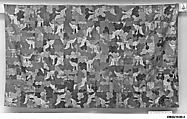
Buddhist Vestment (Kesa) with Pattern of Flowing Water, Chrysanthemums, Fishing Nets, and Waterwheels

18th century
Not on view
The elements of the multicolored design of this textile—sinuous streams, reeds, fishing nets, chrysanthemums, and waterwheels—remain clearly recognizable on its now-faded red background. Buddhist vestments were usually made from donated garments or other textiles that were cut into pieces and assembled into patchwork configurations. This kesa consists of a type of cloth called karaori, in which parts of the design are brocaded in long, floating silk wefts of many colors. The same kind of cloth was used for the type of Noh costume also called a karaori, usually worn as an outer robe for a female role.

Artwork Details

Object Information
  • Title: Buddhist Vestment (Kesa) with Pattern of Flowing Water, Chrysanthemums, Fishing Nets, and Waterwheels
  • Period: Edo period (1615–1868)
  • Date: 18th century
  • Culture: Japan
  • Medium: Twill-weave silk brocaded with silk (karaori)
  • Dimensions: Overall: 45 x 85 in. (114.3 x 215.9 cm)
  • Classification: Textiles-Costumes
  • Credit Line: Purchase, Joseph Pulitzer Bequest, 1919
  • Object Number: 19.93.11
  • Curatorial Department: Asian Art
More Artwork
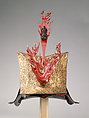
Helmet (<i>Zukinnari Kabuto</i>), Iron, lacquer, Japanese
Japanese
16th century
Seven-Panel Buddhist Monk’s Vestment (Shichijō kesa) with Crane Patterns on Hexagonal Diaper Pattern (Mokkō) Background, Twill-weave silk with supplementary weft patterning (karaori), Japan
Japan
early 17th century
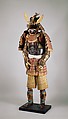
Armor (<i>Gusoku</i>), Saotome Ietada  Japanese, Iron, lacquer, silk, gilt copper, Japanese
Armorer Helmet bowl signed Saotome Ietada
Armorer Breastplate inscribed inside, Myōchin Munesuke
16th and 18th centuries
Buddhist Vestment (Kesa) with Clematis Flowers, Leaves, and Vines, Body of the kesa: brocaded silk twill (karaori); Squares: silk and metallic-thread lampas, Japan
Japan
17th century
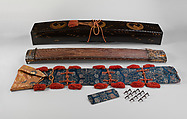
Koto (箏), Metalwork by Goto Teijo, 9th generation Goto master, Japan  Japanese, Various woods, ivory and tortoiseshell inlays, gold and silver inlays, metalwork, cloth, laquer, paper,, Japanese
Metalwork by Goto Teijo, 9th generation Goto master, Japan
Workshop of Gotō Yūjō
early 17th century

Research Resources

The Met provides unparalleled resources for research and welcomes an international community of students and scholars. The Met's Open Access API is where creators and researchers can connect to the The Met collection. Open Access data and public domain images are available for unrestricted commercial and noncommercial use without permission or fee.

To request images under copyright and other restrictions, please use this Image Request form.

Feedback

We continue to research and examine historical and cultural context for objects in The Met collection. If you have comments or questions about this object record, please contact us using the form below. The Museum looks forward to receiving your comments.

Send feedback

Content Notice

The Metropolitan Museum of Art presents over 5,000 years of art from around the world, and our online collection reflects ongoing work conducted over the course of our more than 150-year history. You may encounter objects or images that may be inappropriate for some viewers or information that may be outdated.