The Adoration of the Magi
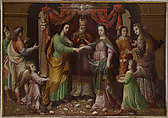
The Adoration of the Magi originally formed part of a series of twelve panels dedicated to the life of the Virgin Mary. Outside a rustic stable, Mary receives three gift-bearing kings who pay homage to the holy child. The artist has used mother of pearl inlays to convey the resplendence of their garments, the gleam of precious metal, and the iridescence of feathers. The inlays are painted, colored with glazes and varnishes, and enriched by the delineation of details in shell gold. Crushed shells fragments are used to imitate the texture of stone masonry. The optical properties of the material, with its shimmering luminosity, are well-suited to the representation of a subject that is fundamentally concerned with the incarnation and revelation of the divine. Unique to New Spain, enconchados are emblematic of the Spanish viceroyalty’s status as a nexus of global commerce and exchange. The material alone references transoceanic trajectories of empire and trade. The influence of Nanban lacquerware, made in Japan for the Iberian market, can be seen in the eye-catching ornamentation the frame. At the same time, although it is less obvious, a debt to pre-Hispanic shellwork traditions can also be detected.
Artwork Details
- Title: The Adoration of the Magi
- Artist: Attributed to Miguel Gonzalez (Mexico, active 1692-1704)
- Date: ca. 1695–1700
- Culture: Mexico
- Medium: Oil on wood, inlaid with mother-of-pearl, gold
- Dimensions: 24 × 33 7/8 in. (61 × 86 cm)
Framed: 33 7/16 × 43 5/16 in. (85 × 110 cm) - Credit Line: Purchase, Louis V. Bell, Harris Brisbane Dick, Fletcher, and Rogers Funds and Joseph Pulitzer Bequest, Maria DeWitt Jesup Fund, and Museo Kaluz Gift, 2022
- Object Number: 2022.408
- Curatorial Department: The American Wing
More Artwork


Related Content
Perspectives
Articles, audio, and video from The Met's online magazine.

Publications
Books, guides, and catalogues published by The Met.
 Free to download
Research Resources
The Met provides unparalleled resources for research and welcomes an international community of students and scholars. The Met's Open Access API is where creators and researchers can connect to the The Met collection. Open Access data and public domain images are available for unrestricted commercial and noncommercial use without permission or fee.
To request images under copyright and other restrictions, please use this Image Request form.
Feedback
We continue to research and examine historical and cultural context for objects in The Met collection. If you have comments or questions about this object record, please contact us using the form below. The Museum looks forward to receiving your comments.
Content Notice
The Metropolitan Museum of Art presents over 5,000 years of art from around the world, and our online collection reflects ongoing work conducted over the course of our more than 150-year history. You may encounter objects or images that may be inappropriate for some viewers or information that may be outdated.