Poems on the Lotus Sutra: “Turning the Lotus of the Wondrous Law” (Hokke-ten)
1. “Introduction” (Jo 序)
26. “Dharani” (Daran i陀羅尼)
27. “The Former Deeds of King Wondrous Splendor” (Myōshōgon-nō honji 妙荘厳王本事)
28. “The Encouragement of the Bodhisattva of Universal Worth, (Samantabhadra)” OR The Encouragement of Samantabhadra, the Bodhisattva of Universal Worth (Fugen bosatsu kambotsu 普賢菩薩勧発).
After the final poem, the work is signed “Shōmon Ryōkan” 沙門良寛, meaning simply “Buddhist monk Ryōkan”
The work was originally conceived as lengthy poetic composition for proselyting the teachings of the Lotus Sutra and was preserved as a folded accordion album (orihon). Over time, it also came to be prized as exemplary calligraphy of Ryōkan’s later years. As is often the case with the most prized Japanese sutra scrolls, poetry collections, or other literary works from premodern times, this orihon was cut up into multiple sections that were remounted as hanging scrolls—suitable for display in a tokonoma (display alcove) at a tea gathering.
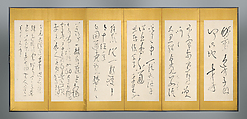
The Met has a small but solid representation of Ryōkan calligraphies in various styles, including the masterpiece pair of screens with Chinese poems in “mad cursive” (kyōsō) script (2023.583.23.1, .2), as well as four other works mounted in the hanging scroll format. We have one other example of Ryōkan’s small standard script (shō-kaisho) from an earlier period of the monk’s career—“Chinese Poem Lamenting the Death of a Friend” (2020.396.27)—eulogizing the death of Tomitori Yukinori, who must have died sometime before or in 1812, when Ryōkan was fifty-five. Ryōkan’s kaisho works are characterized by the loosely connected architecture of each Chinese character violating rules of orthodox handwriting in quirky ways. By avoiding the variations in thickness typical of side-brush techniques and maintaining consistently thin brushstrokes, some characters come across as if brushed by a child unschooled in calligraphy. But it is in this innocence, artlessness, and lack of pretention that makes his brush writing so compelling. In contrast to his epistolary style written in standard script, the kaisho in “Turning the Lotus of the Wondrous Law,” is slightly smaller, more compressed, and less vertical in orientation, as if written within the compass of small squares. It is the style of kaisho that is also seen in surviving examples of his transcriptions of passages from the Lotus Sutra or the entire Heart Sutra (see Shodō Geijutsu [1975], vol. 20, nos. 144–45).
The manuscript of “Turning the Lotus of the Wondrous Law” is believed to date to the end of Ryōkan’s life. In his late fifties, Ryōkan had sought the reclusive life at Mount Kugami, near Izumozaki, the place of his birth by the Sea of Japan. But by 1826, at the age of fifty-nine, he could no longer endure the arduous life of living in a mountain retreat, so he moved down to Otogo Shrine and took up residence in a two-room hut next to the shrine building for ten years.
Ryōkan was an ardent practitioner of the contemplative Sōtō Zen tradition and a devoted student of the Lotus Sutra, a foundational scripture in Mahāyāna Buddhism and a cornerstone of the Sōtō school's scriptural lineage. The concept of “Turning the Lotus of the Wondrous Law” is attributed to Huineng (638–713), the Sixth Patriarch of Chan Buddhism, who criticized passive dependence on the sutra by distinguishing between the enlightened, who actively “turn” the Lotus to actualize its teaching, and the deluded, who are merely “turned by” the Lotus.
Yet this distinction was radically reinterpreted by Dōgen (1200–1253), the transmitter of Sōtō Zen to Japan. Dōgen advocated for the non-duality of the active and passive, viewing the “Turning of the Lotus” as a total actualization of wisdom. In his canonical work, the Treasury of the True Dharma Eye (Shōbōgenzō), the chapter entitled “The Lotus Turns the Lotus” (Hokke-ten hokke) offers an extended commentary on Huineng’s formulation. For Dōgen, there was no fixed contrast between active and passive modes of religious life; whether one is categorized as enlightened or deluded, both states mark different dimensions of the single, unified pursuit of Buddhist wisdom. He envisions “The Lotus Turns the Lotus” as the simultaneous actualization of cause and result, the wisdom of the Buddha in constant, essential motion. Thus, the practitioner is encouraged to immerse in the present moment, where practitioners and the wisdom they seek are revealed as an inseparable reality.
Ryōkan’s verses promote a similar attitude toward the teachings of the Lotus Sutra. Building on Dōgen’s advocacy of immersion, he further understands the Buddha’s preaching and the dialogues of the bodhisattvas described in the sutra as operating in the mode of the Zen kōan. In this context, the sutra’s questions and answers are not treated as static doctrinal information, but as dramatic moments that become subjects of profound contemplation and models for monks seeking wisdom through direct engagement. This approach is grounded in his own contemplative experience.
For example, the final verse included here was inspired by the twenty-eighth and final chapter of the Lotus Sutra: “The Encouragement of the Bodhisattva of Universal Worth” (Samantabhadra). Known as Fugen Bosatsu in Japanese, Samantabhadra is described in this chapter of the Lotus Sutra as taking a solemn oath to protect the merit accrued by those who chant, study, and transcribe the sutra, both in their present and future lives. Monk Ryōkan’s poetic encomium to this chapter and his personal engagement with the sutra reads:
普賢菩薩勸發
幾回生 幾回死 生死悠〃無窮幾
今遇妙法飽聞知 當知普賢威神力
孟夏日永草庵裡 八軸分陀舒又卷
非道敢揮發宗要 聊染禿筆供疏嬾
How many times have we been born,
and how many times have we died?
Birth and death go on and on, without end.
Now that we have encountered
the Wondrous Law [of the Lotus Sutra]
and have heard and known it in full,
one should know the majestic spiritual power
of the Bodhisattva of Universal Worth.
On a lengthening early-summer day, in a grass hut,
unrolling and rolling up the eight chapters of the Lotus Sutra.
It is not that I dare to express its principles,
I merely moisten this worn brush a little
to indulge my own idleness.
(Trans. Tim T. Zhang)
Artwork Details
- 良寛大愚筆 『法華転』
- Title: Poems on the Lotus Sutra: “Turning the Lotus of the Wondrous Law” (Hokke-ten)
- Artist: Ryōkan Taigu (Japanese, 1758–1831)
- Period: Edo period (1615–1868)
- Date: ca. 1826–30
- Culture: Japan
- Medium: Sections of an accordion book (orihon) mounted as a hanging scroll; ink on paper
- Dimensions: Image: 9 1/2 × 29 1/8 in. (24.1 × 74 cm)
Overall with mounting: 41 1/8 × 29 15/16 in. (104.5 × 76 cm)
Overall with knobs: 41 1/8 × 32 3/8 in. (104.5 × 82.3 cm) - Classification: Calligraphy
- Credit Line: Purchase, Sue Cassidy Clark Gift, 2026
- Object Number: 2026.559
- Curatorial Department: Asian Art
More Artwork

Research Resources
The Met provides unparalleled resources for research and welcomes an international community of students and scholars. The Met's Open Access API is where creators and researchers can connect to the The Met collection. Open Access data and public domain images are available for unrestricted commercial and noncommercial use without permission or fee.
To request images under copyright and other restrictions, please use this Image Request form.
Feedback
We continue to research and examine historical and cultural context for objects in The Met collection. If you have comments or questions about this object record, please contact us using the form below. The Museum looks forward to receiving your comments.
Content Notice
The Metropolitan Museum of Art presents over 5,000 years of art from around the world, and our online collection reflects ongoing work conducted over the course of our more than 150-year history. You may encounter objects or images that may be inappropriate for some viewers or information that may be outdated.