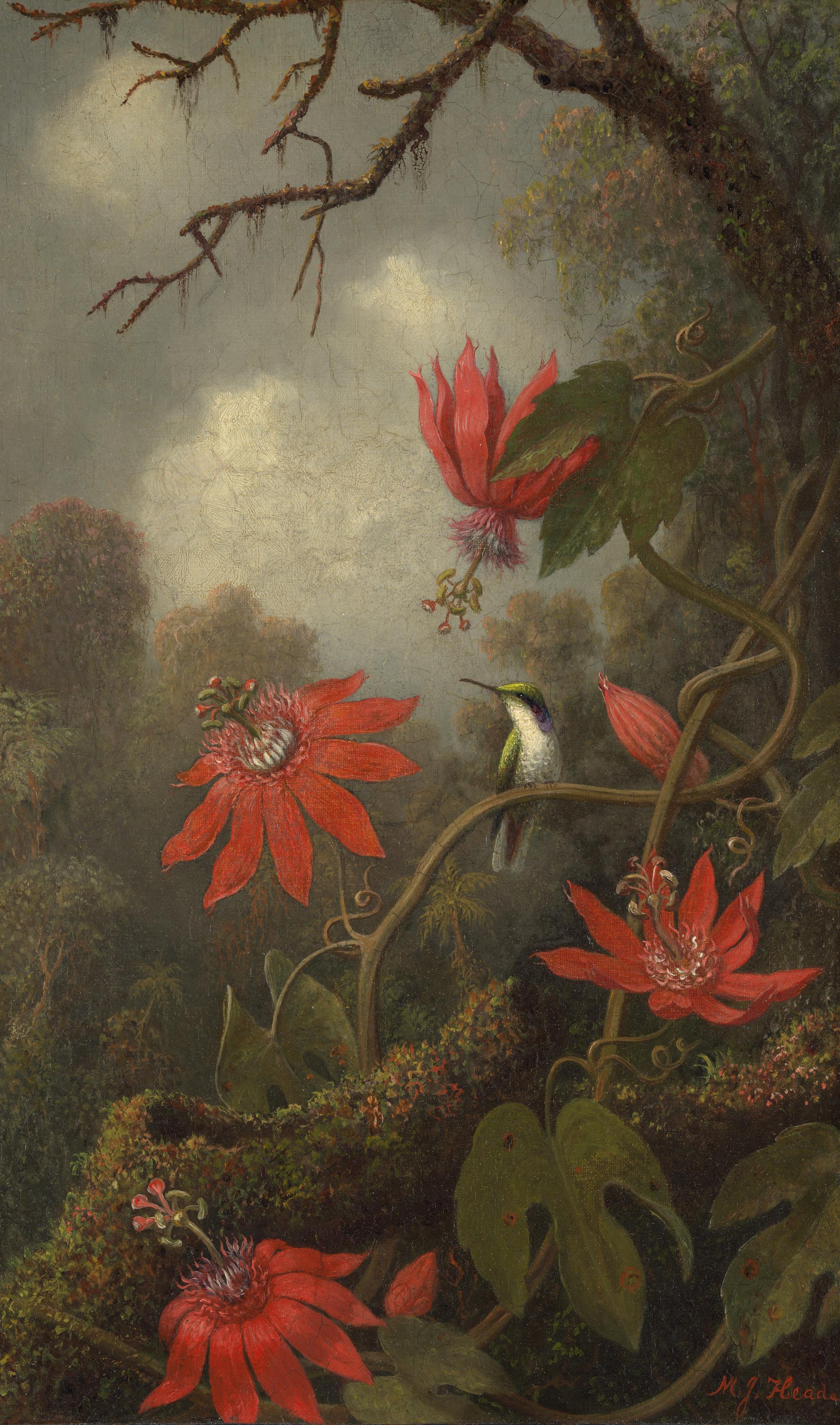
Martin Johnson Heade (American, 1819–1904). Hummingbird and Passionflowers, ca. 1875–85. Oil on canvas, 20 x 12 in. (50.8 x 30.5 cm). The Metropolitan Museum of Art, New York, Purchase, Gift of Albert Weatherby, 1946 (46.17)
My name is Alexis Rockman and I make pop paintings of natural history.
My mom's an archaeologist and I'm very aware of the fragility of civilizations and how many have come and gone. I grew up in Manhattan, but I've always had a sense that we're just like a little eggshell, you know, that's waiting to crack.
I came to this painting because it was a great example of Martin Johnson Heade's travels to Brazil and his ability to construct these highly romantic but scientifically accurate paintings of exotic travel. Someone described Heade as a romantic masquerading as a realist. And this picture is a time capsule and almost a heartbreaking artifact, and that's what attracts me. Because of deforestation this could be the record of the black-eared fairy hummingbird. He originally wanted these paintings to be a field guide. You know, we live in a culture where everyone's very specialized if they're in science. This sense of being a generalist and that an artist could actually contribute to scientific knowledge is virtually impossible now.
Heade is well aware of Darwin and the idea of sexual selection. Passion flowers are about seduction. And it's visual and it's olfactory. What's more fun and interesting and amazingly challenging to paint than a flower? It's high-chroma, it's a sense of symmetry, it has space but it's also almost abstract. And the fact that he's privileging these things that weren't really privileged in art history is fascinating to me.
This is the time when dioramas were really starting to take place. I think that this has something to do with that as well. It's a type of very theatrical thing where it's right in your face, and then the background isn't incidental because it's atmosphere and theatre.
Think about the Grand Tour—that you have to, as an educated gentleman, you have to go to these various places around Europe. I see this as almost like part of that tradition. It's seeing the treasures of America, and that's very much about these natural resources and how do you find the sublime in those things. And I don't understand how Heade got reference for these paintings. Where is he? What's he doing to get reference? The idea that he went to these places gives it a credibility and a sense of authenticity.
I was just in Brazil a couple of months ago. I was thinking about how long it would take to get to Brazil from New York and, you know, we're complaining about this like 11-hour flight. You know, it's just a different sense of perspective.
'Til the 90s, people were buying these in garage sales. People didn't care about his work. Various figures throughout the twentieth century frowned upon the idea of illusionism, and I identify with the underdog. No one could have fathomed that the vastness of South America could be in peril, and that's heartbreaking. It's the idea that these things are worth considering.