Still Life—Violin and Music
Artwork Details
- Title: Still Life—Violin and Music
- Artist: William Michael Harnett (1848–1892)
- Date: 1888
- Culture: American
- Medium: Oil on canvas
- Dimensions: 40 x 30 in. (101.6 x 76.2 cm)
- Credit Line: Catharine Lorillard Wolfe Collection, Wolfe Fund, 1963
- Object Number: 63.85
- Curatorial Department: The American Wing
Audio
4033. William Michael Harnett, Still Life-Violin and Music, 1888
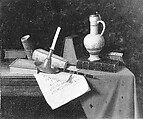
NIKA ELDER: What distinguishes a painting from a print? A painting from a poster? And the answer that Harnett embeds within the painting is that it is this craftsmanship. He's really trying to underscore the value of a painting as a handmade object.
NARRATOR: Set against a wooden cupboard, we can recognize a violin, bow, piccolo and sheet music of an Irish ballad representing the place where the artist was born. Nika Elder, associate professor of art history at American University.
NIKA ELDER: There's a horseshoe, a metallic matchbox, a little cartellino, which is a card that has the artist’s name on it and functions like a signature.
NARRATOR: From the gleaming metal to the convincing cast of shadows, the objects in this still life look so real it’s as if you might grasp them in your hand.
NIKA ELDER: The way the sheet music is slightly torn and that torn piece is turned upwards. Also the small card at the bottom there too you could see the bottom right corner lifts up just a little bit. We know that paper can tip up in those ways.That heightens the realism within the painting.
When we look at it now we might think of it as having a kind of 19th century aesthetic, but even to people in the 19th century it would look kind of old-fashioned. They were living in a moment of rapid industrialization and so this would really look incommensurate with what they would be seeing in stores, at fairs, where a painting like this one by Harnett would be encountered.
Listen to more about this artwork
More Artwork

Related Content
Research Resources
The Met provides unparalleled resources for research and welcomes an international community of students and scholars. The Met's Open Access API is where creators and researchers can connect to the The Met collection. Open Access data and public domain images are available for unrestricted commercial and noncommercial use without permission or fee.
To request images under copyright and other restrictions, please use this Image Request form.
Feedback
We continue to research and examine historical and cultural context for objects in The Met collection. If you have comments or questions about this object record, please contact us using the form below. The Museum looks forward to receiving your comments.
Content Notice
The Metropolitan Museum of Art presents over 5,000 years of art from around the world, and our online collection reflects ongoing work conducted over the course of our more than 150-year history. You may encounter objects or images that may be inappropriate for some viewers or information that may be outdated.