Saint Peter
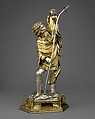
The Saint Peter entered The Met in 1952 identified as a seventeenth-century Roman work. It has recently been reattributed to the Neapolitan transplant Cosimo Fanzago by the present author. Born in a small town near Bergamo, Fanzago was mainly active in Naples, where he died after a long and illustrious career as a sculptor and architect, and where his workshop became a mainstay of artistic production. He produced the statuette to flank a gilt-bronze tabernacle, enriched with lapis lazuli, jasper, and pietre dure and destined for the church of Las Agustinas Recoletas in Salamanca, Spain. The Saint Peter was one of many works in different mediums commissioned in Naples from Fanzago and other artists—including painters, craftsmen, and silversmiths—by Don Manuel de Zuñiga, count of Monterrey and viceroy of Naples. All were executed there and shipped to Spain in late 1637.
The tabernacle is still extant on the high altar of the church in Salamanca. The Saint Peter is recorded in a Spanish inventory in 1676[2] and cited by eighteenth- and nineteenth-century sources together with its pendant, an equally striking gilt bronze Saint Paul, presently in a private collection in New York (fig. 165a). The pair complement each other in stance, gesture, and expression.
Our statuette is an invaluable example of Fanzago’s work in bronze, since much of his considerable oeuvre of metalwork has been lost or irreparably damaged. Of the surviving bronze statuettes, the Saint Peter and its pendant Saint Paul are among the best preserved. They were conceived probably between 1635 and 1636, a time when Fanzago was working on his major monumental marble statues. The two small-scale apostles show a new quest for movement, a more dynamic interaction between figure and space, and a more synthetic and effective treatment of complex masses of drapery. It is as though Fanzago experimented here with stylistic directions that would emerge full-blown in his larger marble projects at the beginning of the 1640s.
-PD’A
Footnotes
(For key to shortened references see bibliography in Allen, Italian Renaissance and Baroque Bronzes in The Metropolitan Museum of Art. NY: The Metropolitan Museum of Art, 2022.)
1. The statuette is remarkably thin and even appears to have been cast in one piece. R. Stone/TR, December 7, 2006.
2. Archivo Histórico Provincial de Salamanca, PN 4439, Matias de Zamora, 1676, c. 1679v.
Artwork Details
- Title: Saint Peter
- Artist: Cosimo Fanzago (Italian, born Lombard, active chiefly in Naples, 1591–1678)
- Date: 1635–36
- Culture: Italian, Naples
- Medium: Bronze, fire-gilt, on a later base
- Dimensions: Overall confirmed: 11 1/8 × 4 3/4 × 3 3/4 in. (28.3 × 12.1 × 9.5 cm)
- Classification: Sculpture-Bronze
- Credit Line: Rogers Fund, 1952
- Object Number: 52.187
- Curatorial Department: European Sculpture and Decorative Arts
More Artwork
Related Content
 Free to download
Research Resources
The Met provides unparalleled resources for research and welcomes an international community of students and scholars. The Met's Open Access API is where creators and researchers can connect to the The Met collection. Open Access data and public domain images are available for unrestricted commercial and noncommercial use without permission or fee.
To request images under copyright and other restrictions, please use this Image Request form.
Feedback
We continue to research and examine historical and cultural context for objects in The Met collection. If you have comments or questions about this object record, please contact us using the form below. The Museum looks forward to receiving your comments.
Content Notice
The Metropolitan Museum of Art presents over 5,000 years of art from around the world, and our online collection reflects ongoing work conducted over the course of our more than 150-year history. You may encounter objects or images that may be inappropriate for some viewers or information that may be outdated.