Reliquary Statuette of Saint Christopher
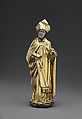
The hallmarks stamped on the hem of the saint's cloak and on the statue's base indicate that this piece was made by a goldsmith in Toulouse. The reliquary, excellently preserved, reveals a masterful treatment of the material. The soft, rich folds of the saint's cloak belie their metal substance. The ungilded surfaces of the faces are framed by the crisp design of the hair. The engraving of the short curls of the Christ Child, the hair and flowing beard of the saint, and the fish in the turbulent water are accented by the juxtaposition of large areas of silver with bright flashes of gilding. A now-lost relic of the saint was placed in the small box covered with crystal on the statue's base, through which the relic could be seen.
Artwork Details
- Title: Reliquary Statuette of Saint Christopher
- Date: ca. 1375–1425
- Geography: Made in Toulouse
- Culture: French
- Medium: Silver and gilded silver
- Dimensions: Overall: 23 7/8 x 11 5/8 x 7 13/16 in. (60.6 x 29.5 x 19.8 cm)
- Classification: Metalwork-Silver
- Credit Line: Gift of J. Pierpont Morgan, 1917
- Object Number: 17.190.361
- Curatorial Department: Medieval Art and The Cloisters
Audio
3160. Reliquary Statuette of Saint Christopher
NARRATOR: This early fifteenth-century silver statue of St. Christopher represents metalwork at its very finest. Every gold curl on the saint’s head is rendered meticulously. His drapery evokes the wind blowing around his body and legs. The empty box at the base indicates that this impressive statue was a reliquary—that it held a relic of St. Christopher.
The expression to carry the weight of the world on your shoulders actually comes from the legend of St. Christopher. Curator Barbara Drake Boehm explains why:
BARBARA DRAKE BOEHM: Now Saint Christopher was a ferryman. And one day, according to his legend, a small child came along and he set the child on his shoulder and began to wade through the waters. As he did so, the child became increasingly heavy…which was of course Jesus, who himself bears the weight of the world. In his left hand he holds an orb with a cross on top and that of course is meant to represent the world. And then if you look very closely you can see that there are tiny fish engraved into the surface of the silver, suggesting that these waters are really very, much alive.
More Artwork
Related Content
 Free to download
Research Resources
The Met provides unparalleled resources for research and welcomes an international community of students and scholars. The Met's Open Access API is where creators and researchers can connect to the The Met collection. Open Access data and public domain images are available for unrestricted commercial and noncommercial use without permission or fee.
To request images under copyright and other restrictions, please use this Image Request form.
Feedback
We continue to research and examine historical and cultural context for objects in The Met collection. If you have comments or questions about this object record, please contact us using the form below. The Museum looks forward to receiving your comments.
Content Notice
The Metropolitan Museum of Art presents over 5,000 years of art from around the world, and our online collection reflects ongoing work conducted over the course of our more than 150-year history. You may encounter objects or images that may be inappropriate for some viewers or information that may be outdated.