English
DonateMembershipTickets

Dish

Manner of Bernard Palissy French
19th century
Not on view
The sixteenth century was marked by a scientific interest in natural phenomena. New worlds had been discovered, occupied by animals and human beings never before seen in Europe. Museums of curiosities abounded, and self-styled naturalists, such as Cosimo de' Medici, gilded armadillos from the Americas and placed them on pillars in their palaces. Native Indians of the Americas toured the courts of Europe, and the taste for the exotic flourished. It was in this atmosphere that the talented French potter Bernard Palissy began practicing his trade. An enthusiastic natural scientist, Palissy used local fish, plants and reptiles—he made casts of actual specimens for use in his modeling—fashioned in a range of colored glazes, to develop what he called "pastoral pottery." Although he is recorded as having produced his rustic ware in abundance, the only documented work by his hand was the grotto (now destroyed) in the garden of the Tuileries. This oval dish, in the manner of Palissy, is in the shape of a pond surrounded by plant life. Perched on the plate are fish, frogs, a twisting snake, a lizard, a water beetle, crayfish, and a variety of occupied shells.

Artwork Details

Object Information
  • Title: Dish
  • Maker: Manner of Bernard Palissy (French, Agen, Lot-et-Garonne 1510–1590 Paris)
  • Date: 19th century
  • Culture: French
  • Medium: Lead-glazed earthenware
  • Dimensions: 2 1/2 × 12 3/4 × 9 5/8 in. (6.4 × 32.4 × 24.4 cm)
  • Classification: Ceramics-Pottery
  • Credit Line: Gift of Julia A. Berwind, 1953
  • Object Number: 53.225.62
  • Curatorial Department: European Sculpture and Decorative Arts
More Artwork
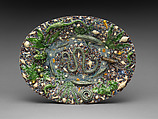
Platter, Bernard Palissy  French, Lead-glazed earthenware, French, Paris
Follower of Bernard Palissy
last quarter 16th century
Ceramic Horn, Glazed pottery, French
French
late 18th or early 19th century
Pilgrim Flask, Bernard Palissy and workshop French, Earthenware with colorless and transparent or opaque pigmented green, purple, blue, yellow, red-brown, and black lead glazes.
Bernard Palissy
probably 1556–67
Osage Warrior, Charles Balthazar Julien Févret de Saint-Mémin  French, Watercolor and graphite on off-white wove paper, American
Charles Balthazar Julien Févret de Saint-Mémin
1805–7
Plate, Lead-glazed earthenware, probably Spanish, Andalusia or Portuguese
probably Spanish, Andalusia or Portuguese
second half 17th century

Research Resources

The Met provides unparalleled resources for research and welcomes an international community of students and scholars. The Met's Open Access API is where creators and researchers can connect to the The Met collection. Open Access data and public domain images are available for unrestricted commercial and noncommercial use without permission or fee.

To request images under copyright and other restrictions, please use this Image Request form.

Feedback

We continue to research and examine historical and cultural context for objects in The Met collection. If you have comments or questions about this object record, please contact us using the form below. The Museum looks forward to receiving your comments.

Send feedback

Content Notice

The Metropolitan Museum of Art presents over 5,000 years of art from around the world, and our online collection reflects ongoing work conducted over the course of our more than 150-year history. You may encounter objects or images that may be inappropriate for some viewers or information that may be outdated.