Feline
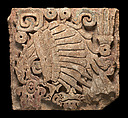
Sculptors carved such feline images in bas relief on large stones in what is now Veracruz, Mexico. A similar example now in the Museo de Antropología de Xalapa (s/n 089) is said to have been recovered at Nopiloa in 1950. In this example the artist preserved as much of the stone as possible using shallow relief to create much of the animal’s form. The fact that most of the boulder was left in its natural state, the figure not carved symmetrically or in the round, underscores the importance of the stone itself. Great lengths and efforts were directed into deeply gouging the eye sockets. These holes may once have held polished cores of obsidian or another material to catch the light and animate the sculpture.
Mesoamerican societies revered big cats as the preeminent killers in nature. Kings and queens wore their pelts, made regalia out of their claws and teeth, and incorporated words for felines into their royal names. The tops of some sculptures of this type have been carved flat or with deep depressions (see MAX 10963, 10957), suggesting they might have served as thrones, alters, or basins for ritual libation.
References
The Metropolitan Museum of Art. Art of Oceania, Africa, and the Americas from the Museum of Primitive Art. New York: The Metropolitan Museum of Art, 1969, no. 548. Museo de Antropología de Xalapa (MAX s/n 089)
Artwork Details
- Title: Feline
- Artist: Nopiloa artist(s)
- Date: 600–1000 CE
- Geography: Mexico, Mesoamerica, Veracruz
- Culture: Central Veracruz
- Medium: Pyroxene andesite
- Dimensions: H. 20 x W. 24 1/2 x D. 32 1/4 in. (50.8 x 62.2 x 81.9 cm)
- Classification: Stone-Sculpture
- Credit Line: The Michael C. Rockefeller Memorial Collection, Gift of Nelson A. Rockefeller, 1963
- Object Number: 1978.412.22
- Curatorial Department: The Michael C. Rockefeller Wing
More Artwork
Research Resources
The Met provides unparalleled resources for research and welcomes an international community of students and scholars. The Met's Open Access API is where creators and researchers can connect to the The Met collection. Open Access data and public domain images are available for unrestricted commercial and noncommercial use without permission or fee.
To request images under copyright and other restrictions, please use this Image Request form.
Feedback
We continue to research and examine historical and cultural context for objects in The Met collection. If you have comments or questions about this object record, please contact us using the form below. The Museum looks forward to receiving your comments.
Content Notice
The Metropolitan Museum of Art presents over 5,000 years of art from around the world, and our online collection reflects ongoing work conducted over the course of our more than 150-year history. You may encounter objects or images that may be inappropriate for some viewers or information that may be outdated.