Ceremonial Axe
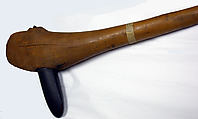
Before the introduction of iron by Euro-Americans in the 19th century, stone axe blades were precious items in the Massim, where most islands are coral atolls lacking hard rocks to be used as wood-cutting tools, indispensable for making food gardens and constructing seagoing canoes. After iron tools became common, polished axe stones retained their status as traditional ceremonial valuables traded in the region. In the Massim, the valuable item is the greenstone axe head proper. Wooden handles are only temporary supports for the blade, carved especially to carry and display the stone during exchange ceremonies. Once it has been inserted in the haft, the stone blade is marked for presentation and exchanged, after which the handle is often discarded until the next exchange cycle demands that a new one be carved.
Archaeological evidence points to a long-extinct greenstone tool industry centered around the quarry of the Suloga hills in Muyuw (Woodlark Island). A common belief throughout the region is that greenstone self-reproduces in river estuaries and water holes where it is normally found, and that people collect these stones and polish them into axe blades. Blades are graded into different named categories depending on their size, polish, hue and the pale green streaks sometimes found in the stone (referred to as “clouds”). The exchange value of each stone is fixed and determined by their dimensions and characteristics. When fitted in the haft, ceremonial axes in the Louisiade Archipelago of the southern Massim region have a detailed anthropomorphic symbolism in which parts of the axe’s handle correspond to body parts. The handle as a whole is considered to be an arm, where the angle is the elbow and the part that holds the blade in place is the hand. The carved mwata snake motif alludes to a creation myth narrating the fight between a giant snake and a colossal buzzard in the southern Massim. The buzzard killed the snake, scattering the bones of the serpent to form the coral atolls of the Calvados Chain.
Greenstone blades are equally important in ceremonial exchanges in many other parts of the Massim, although the shape and symbolism of the carved wooden handles found in other islands may vary when compared to the southern Massim. The relevance of polished greenstone blades in the area is such that people embark on long journeys aboard locally-made dugout canoes with the sole aim of obtaining these valuables ahead of planned funerary rituals.
Sergio Jarillo de la Torre, Sylvan C. Coleman and Pam Coleman Memorial Fund Fellow, 2017
Further reading
Battaglia, Debborah. 1983. “Projecting Personhood in Melanesia: The Dialectics of Artefact Symbolism on Sabarl Island.” In MAN (New Series) 18 (2): 289-304.
Artwork Details
- Title: Ceremonial Axe
- Date: mid- to late 19th century
- Geography: Papua New Guinea, Massim region
- Culture: Massim people
- Medium: Wood, stone, fiber
- Dimensions: H. 27 3/8 × W. 11 3/4 × D. 1 in. (69.5 × 29.8 × 2.5 cm)
- Classification: Stone-Implements
- Credit Line: The Michael C. Rockefeller Memorial Collection, Bequest of Nelson A. Rockefeller, 1979
- Object Number: 1979.206.1526
- Curatorial Department: The Michael C. Rockefeller Wing
More Artwork
Related Content
Research Resources
The Met provides unparalleled resources for research and welcomes an international community of students and scholars. The Met's Open Access API is where creators and researchers can connect to the The Met collection. Open Access data and public domain images are available for unrestricted commercial and noncommercial use without permission or fee.
To request images under copyright and other restrictions, please use this Image Request form.
Feedback
We continue to research and examine historical and cultural context for objects in The Met collection. If you have comments or questions about this object record, please contact us using the form below. The Museum looks forward to receiving your comments.
Content Notice
The Metropolitan Museum of Art presents over 5,000 years of art from around the world, and our online collection reflects ongoing work conducted over the course of our more than 150-year history. You may encounter objects or images that may be inappropriate for some viewers or information that may be outdated.