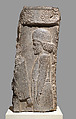
Head of a Persian guard
Most characteristic of Achaemenid sculpture are the slabs carved in low relief that decorate the various stairways leading to the ceremonial buildings. This relief portrays the head of an archer, with his quiver and bow resting on his shoulder. The bow terminates in the head of a duck. This fragment recalls the same imagery seen in the famous Frieze of Archers from the palace at Susa, now in the Louvre. Depictions of soldiers were lined up in groups in order to symbolically guard entrances. Archery was the primary method of attack used in Achaemenid warfare, and was also an essential part of the culture as all young men were taught how to shoot an arrow with precision.
Artwork Details
- Title: Head of a Persian guard
- Period: Achaemenid
- Date: ca. 486–465 BCE
- Geography: Iran, Persepolis
- Culture: Achaemenid
- Medium: Limestone
- Dimensions: 21 1/4 × 24 7/16 × 4 3/4 in. (54 × 62 × 12 cm)
- Credit Line: Purchase, Joseph Pulitzer Bequest, 1955
- Object Number: 55.121.3
- Curatorial Department: Ancient West Asian Art
More Artwork
Research Resources
The Met provides unparalleled resources for research and welcomes an international community of students and scholars. The Met's Open Access API is where creators and researchers can connect to the The Met collection. Open Access data and public domain images are available for unrestricted commercial and noncommercial use without permission or fee.
To request images under copyright and other restrictions, please use this Image Request form.
Feedback
We continue to research and examine historical and cultural context for objects in The Met collection. If you have comments or questions about this object record, please contact us using the form below. The Museum looks forward to receiving your comments.
Content Notice
The Metropolitan Museum of Art presents over 5,000 years of art from around the world, and our online collection reflects ongoing work conducted over the course of our more than 150-year history. You may encounter objects or images that may be inappropriate for some viewers or information that may be outdated.