English
DonateMembershipTickets

Flowers and Grasses of the Four Seasons

Circle of Kano Mitsunobu Japanese
late 16th century
On view at The Met Fifth Avenue in Gallery 226
Unlike the more traditional Four Seasons paintings, which often feature birds, this pair of screens is birdless. Instead, delicately rendered insects—including dragonflies, butterflies, and a praying mantis—hover among kerria roses, peonies, chrysanthemums, bush clover, pampas grass and other autumn grasses, and snow-dusted lantern plants. Tall grasses sway in the foreground, while distant hills emerge between scallop-edged gold clouds, creating patterns that lend the composition a sense of movement. The refined treatment of these motifs reflects the gentle, elegant style associated with Kano Mitsunobu, whose paintings adorned Kyoto’s palaces and temples. The screens also closely parallel the lacquered maki-e panels of Toyotomi Hideyoshi’s mausoleum at Kyoto’s Kōdaiji Temple, which likewise feature autumn grasses and favor insects over birds. These shared motifs suggest a close artistic relationship between the Kano painting style and contemporaneous Kyoto decorative arts.

Artwork Details

Object Information
  • 狩野光信周辺 四季草花図屏風
  • Title: Flowers and Grasses of the Four Seasons
  • Artist: Circle of Kano Mitsunobu (Japanese, 1565–1608)
  • Period: Momoyama period (1573–1615)
  • Date: late 16th century
  • Culture: Japan
  • Medium: Pair of six-panel folding screens; ink, color, gold paint, and gold leaf on paper
  • Dimensions: Image (each): 59 15/16 in. × 11 ft. 7 7/16 in. (152.2 × 354.2 cm)
  • Classification: Paintings
  • Credit Line: Mary Griggs Burke Collection, Gift of the Mary and Jackson Burke Foundation, 2015
  • Object Number: 2015.300.70.1, .2
  • Curatorial Department: Asian Art
More Artwork
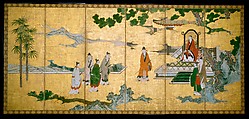
The Return to Court of the Four Graybeards of Mount Shang (right); Su Shi’s Visit to the Wind and Water Cave (left), Kano Mitsunobu  Japanese, Pair of six-panel folding screens; ink, color, gold, and gold leaf on paper, Japan
In the Style of Kano Mitsunobu
late 16th century
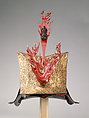
Helmet (<i>Zukinnari Kabuto</i>), Iron, lacquer, Japanese
Japanese
16th century
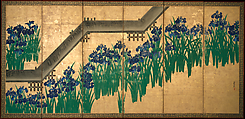
Irises at Yatsuhashi (Eight Bridges), Ogata Kōrin  Japanese, Pair of six-panel folding screens; ink and color on gold leaf on paper, Japan
Ogata Kōrin
after 1709
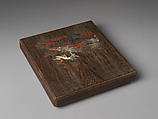
Writing Box (Suzuribako) with Praying Mantis, Ogawa Haritsu (Ritsuō)  Japanese, Cedar wood, lacquer, gold and silver maki-e, mother-of-pearl, ceramic, bone, Japan
Attributed to Ogawa Haritsu (Ritsuō)
first half 18th century
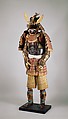
Armor (<i>Gusoku</i>), Saotome Ietada  Japanese, Iron, lacquer, silk, gilt copper, Japanese
Armorer Helmet bowl signed Saotome Ietada
Armorer Breastplate inscribed inside, Myōchin Munesuke
16th and 18th centuries

Research Resources

The Met provides unparalleled resources for research and welcomes an international community of students and scholars. The Met's Open Access API is where creators and researchers can connect to the The Met collection. Open Access data and public domain images are available for unrestricted commercial and noncommercial use without permission or fee.

To request images under copyright and other restrictions, please use this Image Request form.

Feedback

We continue to research and examine historical and cultural context for objects in The Met collection. If you have comments or questions about this object record, please contact us using the form below. The Museum looks forward to receiving your comments.

Send feedback

Content Notice

The Metropolitan Museum of Art presents over 5,000 years of art from around the world, and our online collection reflects ongoing work conducted over the course of our more than 150-year history. You may encounter objects or images that may be inappropriate for some viewers or information that may be outdated.