Ceremonial textile (pua)
Weavers create the designs of pua using warp ikat, a technique in which the warp threads are tied and resist-dyed prior to the weft threads being woven across the loom. The result gives a distinct soft, or slightly blurred edge to the designs. Natural dyes are extracted from plants such as morinda and indigo to create the rich red and blue-black tones. Individual patterns are named, and some are said to appear to weavers in significant dreams.
The cloths form part of almost every major event that accompanies life-stage ceremonies and requires the activation of divine support. They are presented in large quantities as gifts during weddings. During the pining ceremony, pua are laid on the floor and small plates containing goods such as rice, tobacco, and betel chewing materials are placed on top as offerings for the gods. Newborn babies are wrapped in pua while they are carried to the river for their first ritual bath, and during funerary ceremonies, the body of the deceased is placed in an enclosure of pua to contain the dangerous ‘heat’ of the departed’s spirit.
Historically, pua were closely associated with the practice of headhunting, in which men attained status and rank through participation in ritual warfare, and the taking of heads, which they wrapped in the sacred textile during ceremonies to ensure the life essence of the defeated was channeled appropriately towards the strength and prosperity of the community. But while the cloths themselves were gendered male, the weaving of pua was the domain of women, whose powerful mastery over weaving techniques was considered a complementary prestige system or "pathway" to that of male headhunting. Like headhunting, the act of weaving pua was fraught with danger. The textile designs are bisa (venomous) and a weaver must use charms and enlist the appropriate divine support when weaving or risk the vengeful power of the cloths turning against her, causing sickness and even death. As women gained the ability to weave pua designs of greater complexity and power, their rank and status also increased. The most accomplished weavers are accorded the highest status within the community given their ability to weave pua that are highly effective within a range of complex ritual contexts
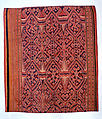
This finely woven pua comprises two similarly patterned and dyed panels that incorporate vivid, neatly executed designs. These include a particularly dramatic section that features rows of interlocking spirit figures (often termed enkarumba, or engamba): double-headed ancestral figures, their arms raised, alternate with single-figured spirits exposing claw-like hands and teeth. Opposite them are variations of the same powerful spirits, their split bodies splayed out beneath a single head or appearing on all fours, crouching low to the ground. All are hidden among a background of tendril-like foliage, purposefully disguised (since their extreme potency demands they not be gazed upon) yet conveying their power to the wearer while worn or displayed during ritual protocols. The elaborate turning tendril motif, whose circular turns are complete in this example, is complex to achieve, demonstrating the high skill and extreme competency of the weaver of this piece. Designs in the center and in the trio of patterned side stripes are created by black, white and red warp ikat with natural dyes. These areas are both flanked and separated by groups of narrow stripes (different widths) in red, black, tan and white.
Artwork Details
- Title: Ceremonial textile (pua)
- Date: Late 19th–early 20th century
- Geography: Malaysia, Borneo
- Culture: Iban people
- Medium: Cotton (both handspun and factory spun), commercial and natural dyes
- Dimensions: H. (without fringe) 79 1/2 × 46 in. at widest (201.9 × 116.8 cm)
H. (with fringe) 83 in. (210.8 cm) - Classification: Textiles
- Credit Line: Gift of Sheldon and Barbara Kent, 2018
- Object Number: 2018.935.3
- Curatorial Department: The Michael C. Rockefeller Wing
More Artwork
Research Resources
The Met provides unparalleled resources for research and welcomes an international community of students and scholars. The Met's Open Access API is where creators and researchers can connect to the The Met collection. Open Access data and public domain images are available for unrestricted commercial and noncommercial use without permission or fee.
To request images under copyright and other restrictions, please use this Image Request form.
Feedback
We continue to research and examine historical and cultural context for objects in The Met collection. If you have comments or questions about this object record, please contact us using the form below. The Museum looks forward to receiving your comments.
Content Notice
The Metropolitan Museum of Art presents over 5,000 years of art from around the world, and our online collection reflects ongoing work conducted over the course of our more than 150-year history. You may encounter objects or images that may be inappropriate for some viewers or information that may be outdated.